


“Ethnic nose shape” is one of the most searched phrases in rhinoplasty—and one of the most misunderstood.
Some people use it to describe a nose that doesn’t fit traditional “Caucasian” rhinoplasty templates. Others use it because they’re looking for a surgeon who can refine the nose without erasing identity. And many people simply want to understand why their nose looks the way it does—and what changes are realistically possible.
This blog explains what the term generally means, the common features surgeons consider in African, Asian, Hispanic, Middle Eastern, and Indigenous noses, and how ethnic rhinoplasty is designed to deliver refined, natural-looking results that still feel like you.
What does “ethnic nose shape” mean?
“Ethnic nose shape” is not a medical diagnosis. It’s a non-clinical term commonly used to describe nasal characteristics that are often associated with different ancestral backgrounds.
Important nuance: no ethnic group has one “standard” nose. Even within the same family, noses can vary dramatically. That’s why modern rhinoplasty focuses on your anatomy, not a stereotype—and why ethical surgeons avoid pushing a single beauty ideal.
In practice, when patients search “ethnic nose,” they usually mean:
- Their nose has features not typically addressed well by older, Eurocentric rhinoplasty approaches
- They want refinement while preserving cultural or familial resemblance
- They want an expert plan for anatomical factors like thicker skin, a lower bridge, a wider base, or a softer tip definition
Why this topic needs a modern, respectful approach
Rhinoplasty is more than “changing a nose.” It’s changing a feature tied to identity, family resemblance, and culture.
Ethnic rhinoplasty has evolved because patients increasingly ask for results that:
- Look elegant and harmonious
- Don’t “Westernize” the face
- Still preserve character and identity
The goal is not to copy someone else’s nose. The goal is to create a nose that fits your facial proportions—with respect for what makes you, you.
Ethnic vs Caucasian nose shapes (a brief, practical comparison)
People often contrast “ethnic” and “Caucasian” noses. That comparison can be helpful only if we keep it simple and anatomical:
- Many Caucasian rhinoplasty cases involve refining a higher bridge, narrowing a prominent dorsum (a “hump”), or defining a tip with relatively thinner skin.
- Many ethnic rhinoplasty cases involve supporting a lower bridge, improving tip projection/definition under thicker skin, adjusting alar width (nostril base), or improving symmetry while keeping natural features.
Both require artistry and technical skill—just with different planning priorities.

Common features seen in different ethnic groups (with big caveats)
This section is a guide to patterns surgeons may see—not a checklist. Your nose is yours, and your plan should be built around your structure and goals.
African descent
Some patients of African descent may have:
- A wider nasal base (alar width)
- A lower bridge/dorsum
- A rounder or softer tip definition
- Thicker skin that affects how sharply the tip can be defined
Ethnic rhinoplasty here may focus on creating better balance—often through careful tip support, refined definition, and (when desired) conservative narrowing of the nostril base while keeping a natural look.
East/Southeast Asian
Some East/Southeast Asian noses may have:
- A lower nasal bridge
- A softer tip with less projection
- Thicker skin in the tip area
- A wider base in some cases
Ethnic rhinoplasty frequently emphasizes bridge and tip support and proportion—aiming for elegance without making the nose look “imported” or mismatched to the face.
South Asian
South Asian noses can be highly varied, but some common themes include:
- Bridge projection that may be moderate to high
- Tip definition concerns
- Occasional dorsal irregularities (like a hump)
- Potential asymmetry
Planning often combines proportion-focused refinement with maintaining the patient’s natural character.
Hispanic/Latinx
“Hispanic/Latinx” covers many backgrounds (Indigenous, European, African, and mixed heritage), so nasal anatomy varies widely. Some patients may present with:
- A wider base
- A softer tip
- Bridge concerns (either low or prominent depending on ancestry)
- Thick-to-moderate skin
Ethnic rhinoplasty here is all about personalization—balancing refinement with heritage-sensitive aesthetics.
Middle Eastern / North African
Middle Eastern and North African noses also vary by region, but concerns can include:
- A prominent dorsum (“hump”)
- Tip droop or under-rotation
- Width concerns in the upper or middle vault
- Functional concerns (breathing issues) in some cases
Ethnic rhinoplasty can refine the bridge and tip while keeping a strong, natural presence—rather than over-reducing and losing identity.
Indigenous populations
Indigenous nasal anatomy varies widely across regions and communities. A respectful approach means:
- Avoiding one-size ideals
- Prioritizing facial harmony and proportion
- Preserving cultural identity while addressing the specific features the patient wants to improve
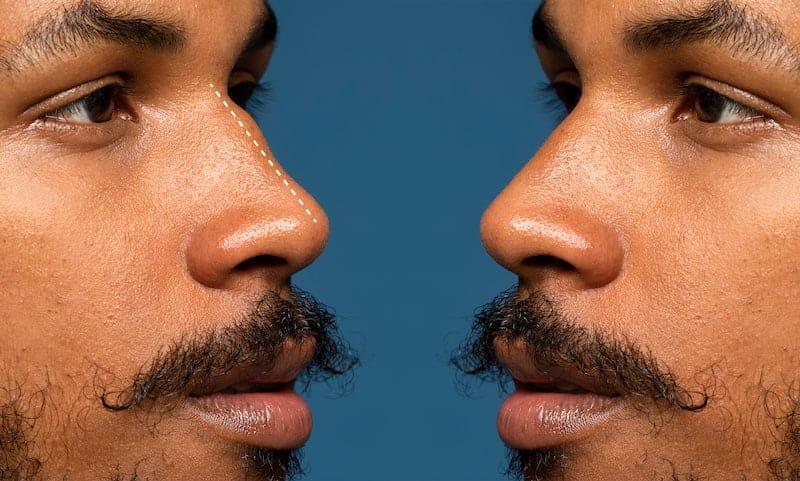
What is ethnic rhinoplasty?
Ethnic rhinoplasty is a specialized approach to nose surgery that aims to refine the nose while preserving culturally distinct features and respecting facial harmony.
It’s not a separate “type” of surgery in the sense of one technique—think of it as a planning philosophy plus advanced technical strategies adapted to anatomy that may include:
- Thicker skin
- Different cartilage strength and tip support needs
- Lower bridge profiles
- Wider alar base / nostrils
- Different aesthetic goals and “natural” endpoints
Modern ethnic rhinoplasty is built around one question: How do we improve what bothers you—without making your face look unfamiliar?
Goals and techniques in ethnic rhinoplasty
Ethnic rhinoplasty is usually goal-driven. Patients often request one or more of these refinements:
1) Bridge balance (not always “higher”)
Some patients want a more defined bridge; others want a smoother profile; some want subtle refinement only. The right approach depends on facial proportions, skin thickness, and structural support.
2) Tip definition and projection
Tip work is where ethnic rhinoplasty becomes highly technical. With thicker skin or softer cartilage, the goal is often stronger support and cleaner shape—without making the tip look pinched or artificial.
3) Nostril base width (alar base) refinement
If the base of the nose feels wide, alar base refinement can narrow it—carefully—so it still suits your face and looks natural from the front and ¾ view.
4) Symmetry and proportion
Many patients are more concerned about asymmetry than they realize until consultation photos are taken. Small structural refinements can make a big difference.
5) Function (breathing) when relevant
Rhinoplasty can address appearance and function, but not every patient needs functional work. This is assessed during consultation.

What to expect: consultation, surgery, recovery, results
Consultation (where the “right result” is defined)
A high-quality consult should cover:
- Your goals in plain language (what you want more/less of)
- Whether your desired change fits your anatomy
- What can be done in one surgery vs what may require staged planning
- How your skin thickness impacts definition
- A realistic discussion of healing timelines
Surgery and anesthesia
Rhinoplasty can be performed under different anesthesia plans depending on the case complexity and patient health. Your surgeon will recommend the safest option for you.
Recovery (what most patients don’t realize)
Rhinoplasty is a “long game.” You’ll see early improvements relatively soon, but refinement continues over time. Swelling resolves gradually, and the tip often takes the longest to settle—especially in thicker skin.
Results
Ethnic rhinoplasty aims for results that look:
- Balanced from the front and side
- Natural in motion and real life (not just selfies)
- Consistent with your identity

Risks and important considerations
All surgery has risks, and rhinoplasty is a complex procedure. Your surgeon should discuss your personal risk profile, but general considerations include:
- Bleeding, infection, prolonged swelling
- Changes in sensation (often temporary)
- Asymmetry or under/over-correction
- Healing differences that affect definition
- Possibility of revision in a minority of cases
A consultation is essential for personalized guidance and safe planning.
Cost at Vanity: starting from €3850
Ethnic rhinoplasty starts from €3850. Pricing depends on:
- Complexity (bridge, tip, base width, symmetry)
- Whether functional correction is included
- Surgical approach and operating time
- Individual anatomy and revision vs primary surgery
The most accurate quote is given after an assessment, once your surgical plan is defined.
The page content is for informational purposes only. The content of this page does not include items containing information on therapeutic health care. For diagnosis and treatment, you must consult your physician or consult the physicians in our clinic. The content has been written regarding the following sources by Vanity Estetik doctors.
Sources
- [1]Ethnic Variations and Surgical Outcomes in Rhinoplasty: A Systematic Review · PubMed · 2025
- [2]Considerations in ethnic rhinoplasty · PubMed (Facial Plast Surg) · 2003
- [3]Outcomes of Open Versus Closed Rhinoplasty: A Systematic Review and Meta-analysis · PubMed (Plast Reconstr Surg Glob Open) · 2025
- [4]Nose reshaping (rhinoplasty) · NHS
- [5]Rhinoplasty · American Society of Plastic Surgeons