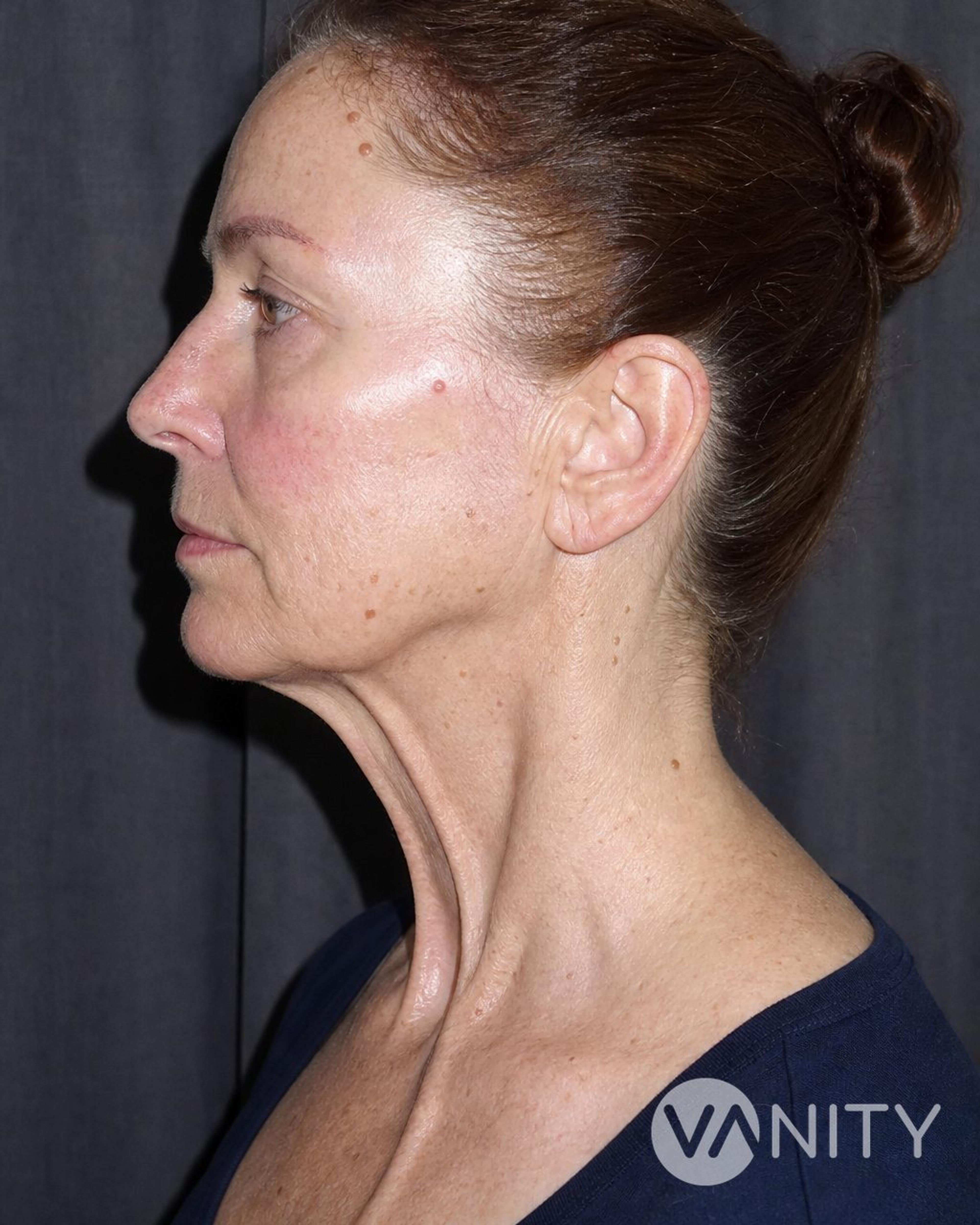
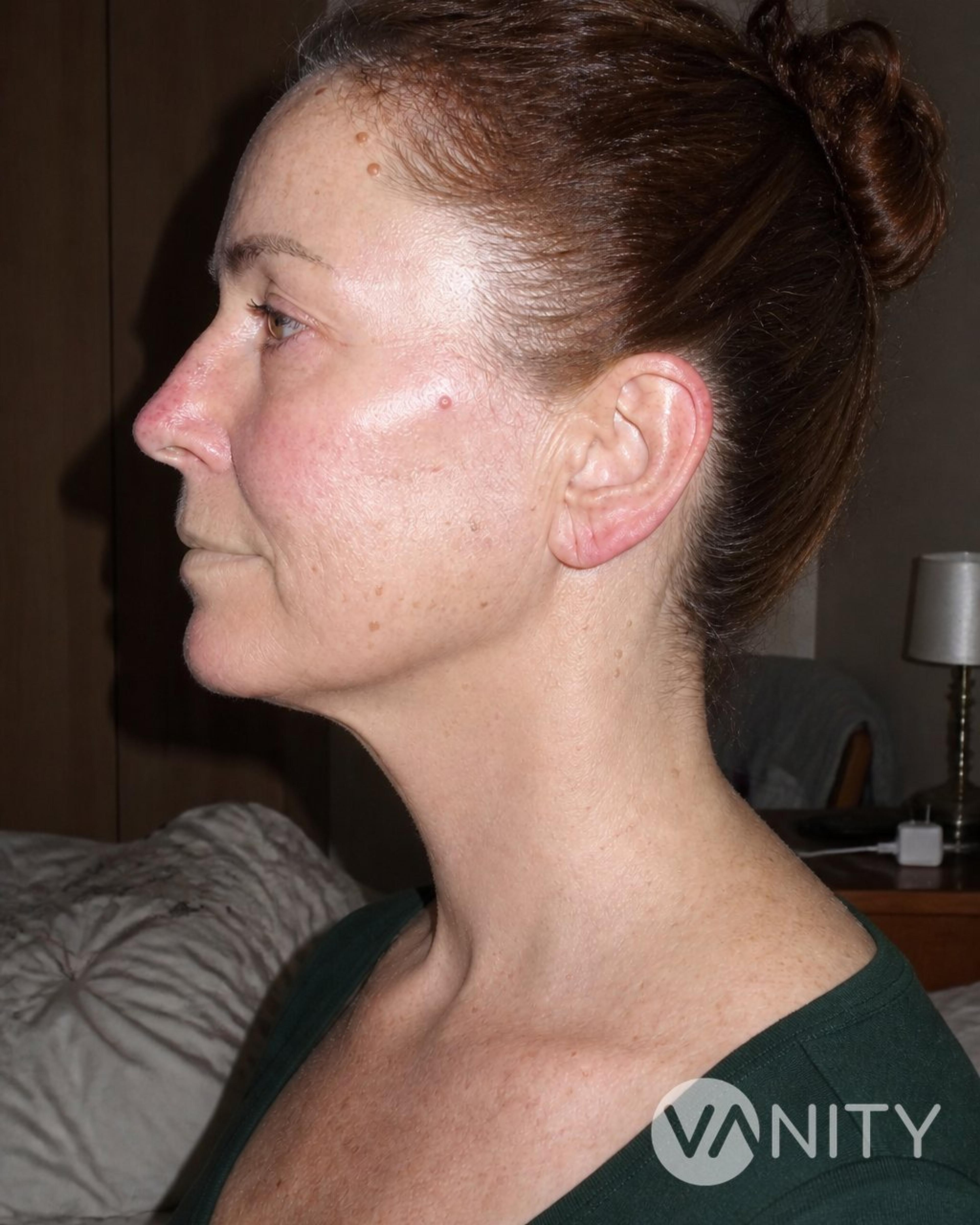



Platysmaplasty: what it is
The platysma is a thin, broad sheet of muscle running from the collarbone up over the jawline. In youth its two halves interlock at the midline of the neck; with age that seam and the fascia supporting it loosen, and the free inner edges fall forward as the vertical cords most people call neck bands. Platysmaplasty works on that muscle layer directly. Through an incision hidden in the crease under the chin — sometimes with additional incisions around the ear — we remove fat above and, where it is indicated, beneath the muscle, stitch the two medial edges back together, and where banding persists divide the muscle transversely low in the neck to release it. What changes is contour: a flatter neck and a cleaner angle between chin and neck.
It suits people roughly 40 to 60 with a soft cervicomental angle, an indistinct jawline, visible banding and a small to moderate amount of fat under the chin — but whose midface is still stable. If there is real jowling or descent where the neck meets the face, neck surgery alone will not correct it and the result will read as unfinished; a facelift belongs in the plan instead. Above 60, excess skin usually has to be excised as well. We do not operate on people who are still smoking, on anyone whose psychiatric condition is unstable, or on anyone whose expectation is a neck their anatomy cannot produce.
Platysmaplasty: techniques we use
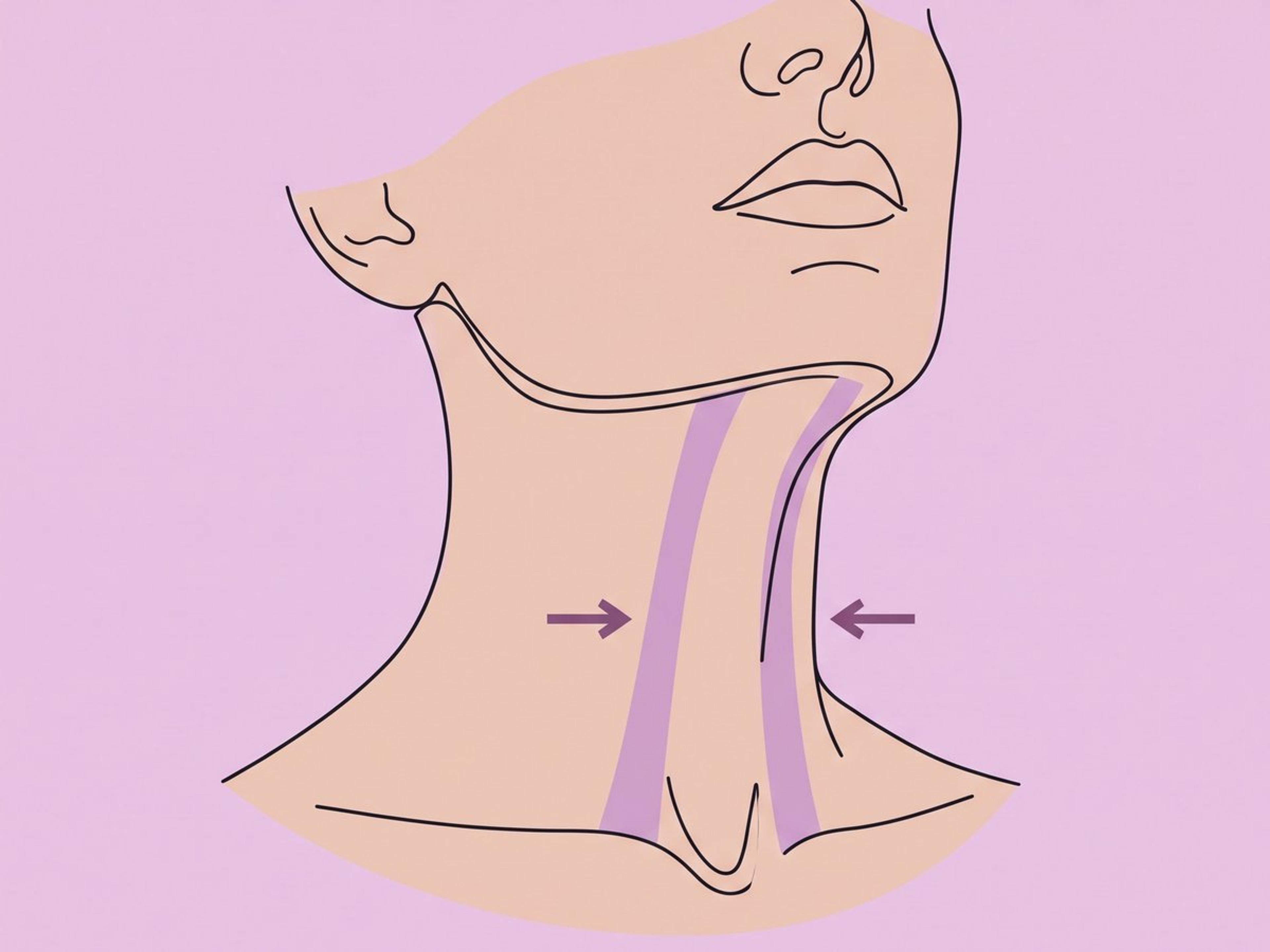
The common approach, done through the incision under the chin. The separated medial borders of the platysma are brought together edge-to-edge with permanent sutures, usually from the point of the chin down to the level of the thyroid cartilage. It re-creates the midline seam that age took apart.
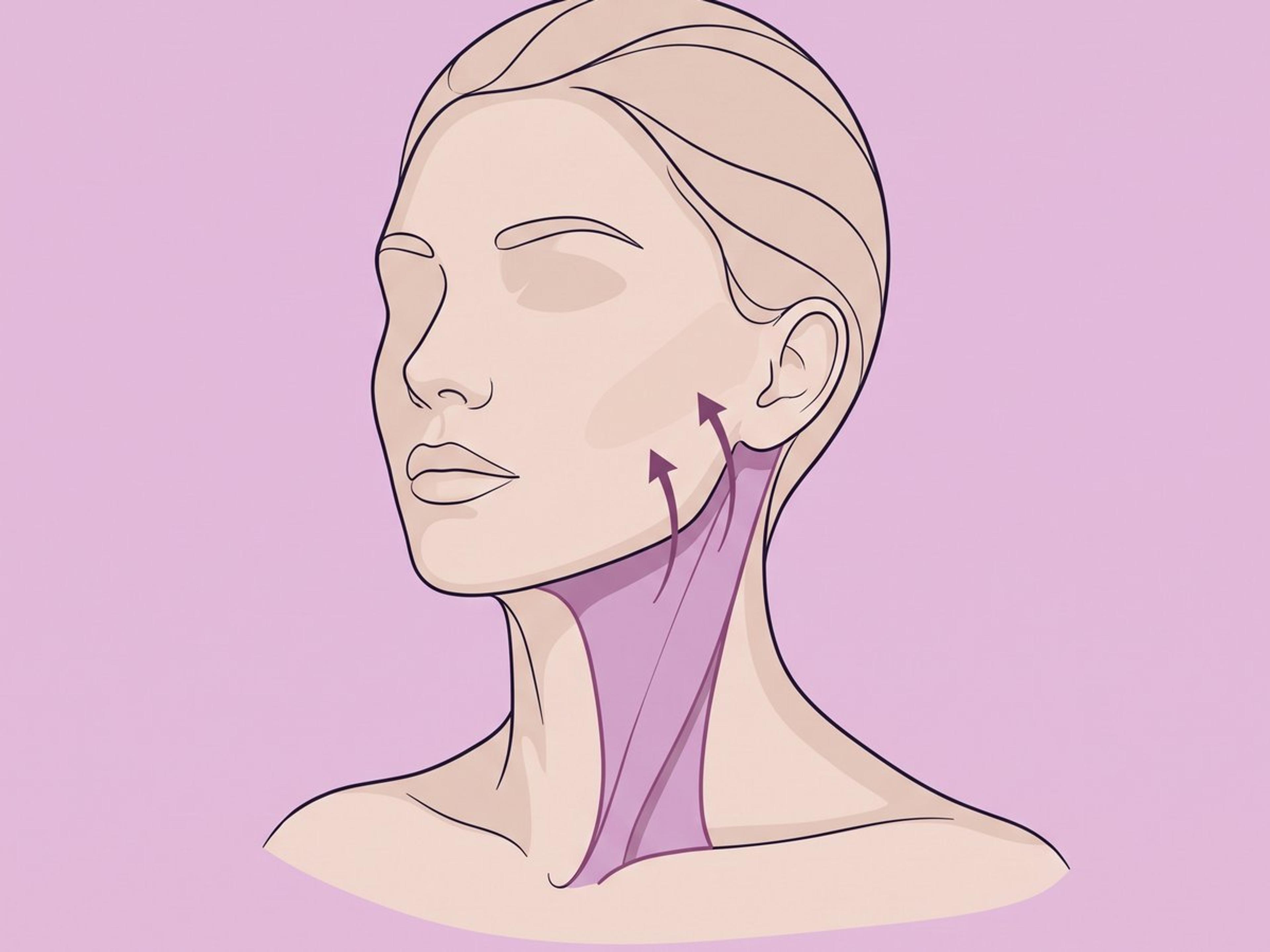
Performed after the midline work: the lateral platysma is suspended to the fascia of the upper sternocleidomastoid. It takes up mild horizontal slack in the muscle and adds the support from above and to the side that midline suturing on its own does not provide.
The operation, step by step
Marking, sitting up
The bands are marked before you are anaesthetised, upright and with the muscle contracting, because cords that are obvious across a table can flatten out completely once you are lying down. This is also where it is decided whether the midline incision alone will do the job or whether skin excess needs incisions around the ear as well.
Access under the chin
General anaesthesia or IV sedation with local, then a short incision in the natural submental crease. It is placed in the shadow of the crease rather than on the flat of the neck so that the mature scar sits where nobody looks.
Fat reduced in layers
Fat above the platysma is reduced first, and the fat beneath the muscle is addressed only where it is genuinely what is holding the neck angle open. The restraint matters: over-resection leaves an adherent, skeletonised neck that reads as older, and it removes the padding that would otherwise hide small contour irregularities.
The muscle brought back together
The separated medial borders of the platysma are sutured edge to edge — plication, or a continuous corset seam — and where a band still lifts against the repair, the muscle is divided transversely low in the neck to release it. Rebuilding this midline seam is what flattens bands; pulling on skin alone does not, which is why skin-only tightening relapses so quickly.
Drain, closure, and the first night
A fine drain is often left to take away fluid before it can collect, the incision is closed with fine sutures, and a compression garment supports the repair. You stay one inpatient night because roughly 90% of haematomas after face and neck lifting declare themselves inside the first 24 hours, and that is the window in which you want an operating theatre in the same building.
Platysmaplasty: recovery week by week
- Day 1
Same-day discharge is usual after general anaesthesia ; if you have travelled to us, you stay one night. A soft dressing or compression garment supports the neck, and a thin drain may be in place to catch fluid before it can collect. You keep your head above the level of your heart. We do not put ice on the neck — it narrows the vessels feeding skin whose blood supply has just been disturbed.
- Week 1
Swelling and bruising peak, then begin to settle. Antibiotics and pain relief usually run for about a week. Drains and dressings come off in this window and sutures typically come out. No twisting or bending the neck, no lifting, no alcohol, no aspirin.
- Week 2
Most people are back at desk work somewhere between 7 and 14 days. The bruising has largely gone and the new contour is visible, but the neck is still swollen and firm, and numbness around the incisions is common at this stage.
- Weeks 3–4
Sport and hard physical work generally resume at 2 to 3 weeks, depending on how much was done. Tightness in the muscle and firmness under the chin are still there. Both are expected, and neither means something has gone wrong.
- Months 3–6
The last of the swelling resolves and the scar matures. This is when the final contour is judged — not before. Altered sensation can take weeks to months to return to normal.
Platysmaplasty: how to prepare
- Stop smoking and all nicotine well before the date — vapes and pouches included. Uncontrolled smoking is a contraindication, not a preference: it impairs blood supply to skin that has just been lifted.
- Stop aspirin, NSAIDs, anticoagulants and any supplement that increases bleeding risk, on the schedule your surgeon gives you. Disclose everything you take, including what you would not think of as medication.
- Complete the preoperative work-up — bloods, anaesthetic review and any medical clearance we ask for. Blood pressure that is not under control raises haematoma risk and is worth treating before surgery rather than after it.
- Plan for a neck that cannot move. For the first week you sleep propped head-up, you do not turn or extend the neck, and you do not lift — so sort out pillows, front-opening clothes you never pull over your head, and anything you would otherwise have to reach for.
- Have the compression garment, dressings and prescriptions in hand before the day, and know who to call. A 24-hour clinical contact number is part of what we give you.
Platysmaplasty: risks
Every operation carries risk. We name them so you can ask the right questions.
- Haematoma — a collection of blood under the skin, and the most urgent early complication. Small collections can be drained through the skin; an expanding haematoma is an emergency and returns to theatre. Reported at around 3% in isolated neck surgery, and about 90% present within the first 24 hours.
- Seroma, wound infection
- Nerve injury
- Contour irregularity, asymmetry, or over-resection producing an over-skeletonised neck that reads as older rather than younger.
- Unfavourable scarring, poor wound healing, skin loss, prolonged swelling, and rarely deep vein thrombosis with cardiac or pulmonary consequences.

Platysmaplasty in Turkey: what to expect
Coming to Turkey for a neck adds something domestic surgery does not have: you cannot simply drive back if something needs looking at. So the trip is built around the two windows that matter — the first 24 hours, when almost all haematomas declare themselves, and the first week, when the sutures come out and the neck is still fragile.
Before you fly
Talk to the surgeon, before you travel — by name, and about your neck specifically.
At the clinic
You arrive the day before surgery for bloods, anaesthetic review and surgical marking. Surgery is the following day, under general anaesthesia or IV sedation, and takes 2 to 3 hours depending on how much is done. You stay one inpatient night. Accreditation is a floor for the things that matter if something goes wrong at 03:00 — anaesthesia standards, sterile technique, blood availability, and a clear route back to theatre — not a warranty of your result. Your result rests on the surgeon.
Recovery in Istanbul
Plan on 9 days in total, with 7 hotel nights around the inpatient one, and 3 scheduled reviews: a drain and dressing check around day 3, suture removal around day 6, and a final clearance and fitness-to-fly assessment around day 8. Choose a hotel a short transfer from the clinic, ideally one that can supply extra pillows or an adjustable bed. Bring someone with you — for that first week you sleep head-up and cannot turn or extend your neck or lift anything, which makes an airport and an unfamiliar city harder than it sounds.
Heading home
Day 10 is the sensible target and day 7 the floor. ASPS advises waiting 7 to 10 days after cosmetic procedures of the face before flying.
Checking a clinic in Turkey
Turkey rewrote its medical-tourism rules on 26 April 2025, replacing the 2017 regulation. Any facility treating international patients must now hold an international health tourism authorisation certificate, register on the Ministry of Health's HealthTürkiye portal, and carry complication insurance for the procedures it performs; hospitals and medical centres also had to complete TÜSKA accreditation by the end of that year. Facilities are required to publish that certification — so you can check ours, and you should check anyone else's before you pay a deposit.
On the face the surgeon matters more than the building, because the margin for error is millimetres and the result is the first thing anyone sees. Ask how many of this specific operation they perform a year, ask to see their own patients at one year rather than at two weeks, and ask what they would decline to do in your case — a surgeon who never says no is telling you something. Ask for their Turkish Medical Association registration. If an agency rather than the clinic is arranging the trip, get it in writing who holds clinical responsibility once you have flown home.
Most nationalities enter Turkey visa-free or on an e-Visa for a stay of this length, with a passport valid at least six months. Confirm the rule for your own passport, and build the return flight around the last clinic visit rather than fixing it in advance.
- United Kingdom
- £5,000 – £9,000
- United States
- $9,000 – $15,000
- Western Europe
- €6,000 – €10,000
Published typical ranges for orientation — confirm with a local quote.
Platysmaplasty: frequently asked questions
What is the difference between a platysmaplasty and a neck lift?
Platysmaplasty means tightening the platysma muscle specifically. A neck lift, or lower rhytidectomy, is the broader operation that may also include liposuction of fat under the chin and excision of loose skin. In practice a full neck lift contains a platysmaplasty as its muscular component, which is why the two words are used interchangeably in most patient-facing material.
Will platysmaplasty get rid of my neck bands permanently?
It flattens visible bands reliably, but recurrence over long time frames is well documented and we would rather you heard that now.
Can Botox treat platysmal bands instead of surgery?
Botulinum toxin softens dynamic platysmal bands and is used both as a non-surgical alternative and to manage bands that persist after surgery. It does not remove excess skin or fat, and its effect is temporary. When laxity and volume are the main problem, it is not a substitute.
How long does the scar under my chin stay visible?
The primary incision sits in the natural crease under the chin and is short and well concealed once healed. Scar maturation takes several months. Unfavourable scarring is a recognised risk and varies with skin type, healing and smoking status — we cannot promise you a particular scar.
Do I need a facelift as well?
It depends on the midface. If there is significant jowling or descent where the neck meets the face, an isolated neck procedure will not correct it and the result will be suboptimal, so a combined facelift is indicated. People whose laxity is confined to the neck, with a stable midface, are the ones who do well with neck surgery alone.
How long is the recovery before I look presentable?
Most people return to non-physical work in 7 to 14 days, once the bulk of the bruising has settled. More strenuous activity and sport usually wait 2 to 3 weeks. It takes several months for the last of the swelling to go and the final contour to appear.
Is one night as an inpatient really necessary?
In domestic practice this is a day case and people go home the same evening. We keep travelling patients one night because roughly 90% of haematomas after face and neck lifting present within the first 24 hours, and that is the window in which you want to be in a building that has an operating theatre.
How much does platysmaplasty cost, in the United States and in Istanbul?
The American Society of Plastic Surgeons lists an average surgeon fee of $7,885 for a neck lift in the United States. That figure excludes anaesthesia, operating room and facility costs, tests, prescriptions and garments, so the real total is meaningfully higher. In Istanbul the operation is typically quoted as €2350 to €4100 that does include theatre, anaesthesia and one night — so the two numbers are not measuring the same thing.
Who should not have a platysmaplasty?
Anyone still using nicotine in any form — smoking constricts the very vessels that have to keep lifted skin alive, and it is the single clearest reason we postpone. Uncontrolled high blood pressure and bleeding disorders, or blood thinners that cannot safely be paused, all belong in the same category, because haematoma is the complication this operation is most likely to hand you. We also decline where the psychiatric picture is unstable or where what is being asked for is a neck the underlying anatomy cannot produce; and if the midface has descended, the honest answer is a facelift, not a neck operation that will look unfinished.
Which symptoms after surgery need urgent attention?
Swelling that increases quickly, especially on one side, with tightness and pain out of proportion to what you were told to expect — that is how an expanding haematoma presents, and it is an emergency that goes back to theatre rather than something to sit on overnight. Any difficulty breathing or swallowing means immediate care. So do fever, spreading redness, or discharge from the incision, and so does calf pain or sudden breathlessness, which point at clot rather than wound. Use the 24-hour number rather than waiting for your next scheduled review; there is nothing on that list we would rather hear about late.
Will this give me the sharp jawline I have seen in photographs?
This is the commonest misunderstanding about neck surgery. How crisp an angle your neck can hold is set largely by things the operation does not move: the position of the hyoid bone, the bulk and drop of the submandibular gland, the digastric muscles, and how far the chin projects. A low or forward-set hyoid puts a ceiling on the angle no amount of muscle tightening will lift. Platysmaplasty works on muscle, fat and skin, and within those limits it works well — which is why we assess the skeleton and the glands at consultation and tell you the ceiling then, rather than after.
How much does platysmaplasty cost in Turkey?
€2,350 to €4,100 with us, confirmed after a consultation rather than quoted blind. For comparison it is typically £5,000 – £9,000 in the United Kingdom, $9,000 – $15,000 in the United States and €6,000 – €10,000 in Western Europe. It depends on whether the platysma is tightened alone or liposuction and skin excision are added. A neck with loose skin is a different operation from one with a loose muscle.
Sources
- [1]Neck Lift Risks and Safety · American Society of Plastic Surgeons · 2025
- [2]How to Prevent and Treat Complications in Facelift Surgery, Part 1: Short-Term Complications · Aesthetic Surgery Journal Open Forum (PMC) · 2021
- [3]Platysmaplasty Facelift — StatPearls · NCBI Bookshelf / National Library of Medicine · 2023
- [4]Corset platysmaplasty · Feldman JJ, Plastic and Reconstructive Surgery (PubMed) · 1990