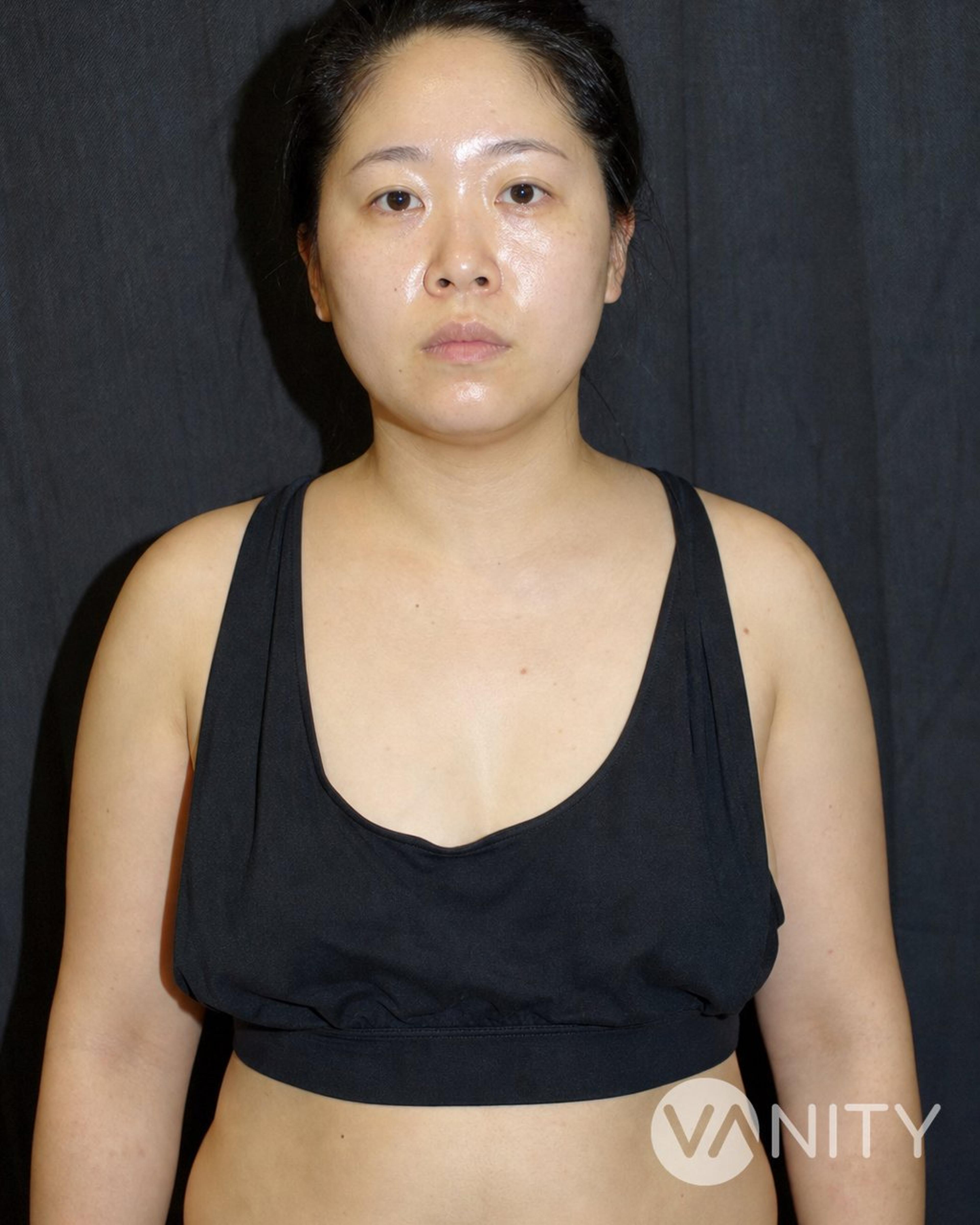
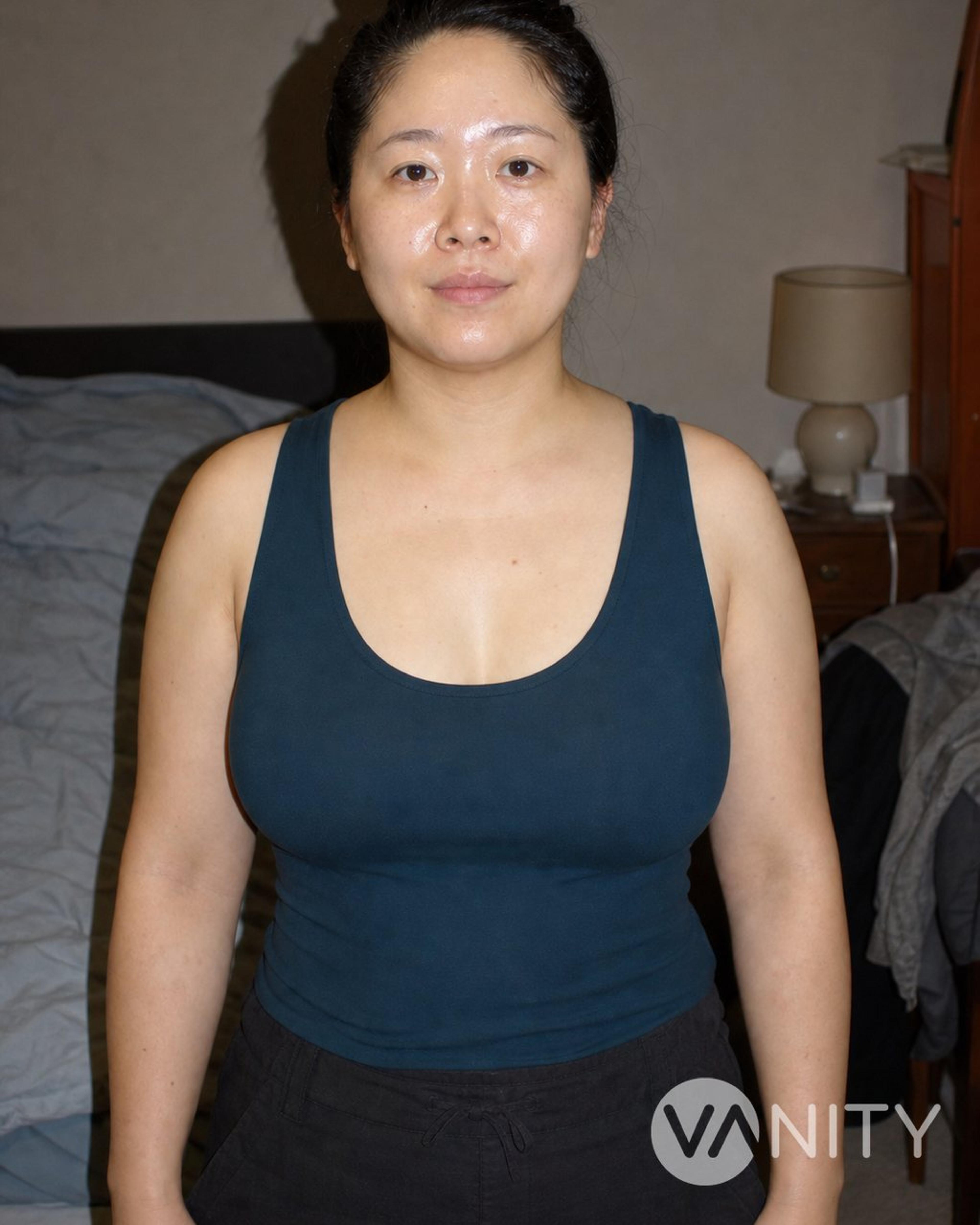



Breast fat transfer: what it is
Fat transfer breast augmentation is two operations in one. We take fat by liposuction from the abdomen, flanks or thighs, process it to separate living fat cells from oil, blood and fluid, then inject it into the breast in many fine passes rather than as a single bolus — spread through the layer under the skin and behind the gland, so every parcel sits close to a blood supply. Not all of it survives, so we deliberately overfill. Published mean retention is about 62 percent, with a reported range of roughly 45 to 83 percent, and most of the loss happens in the first 3 months.
It suits people who want a modest increase with a natural feel and no implant — often upper-pole fullness lost after pregnancy or breastfeeding, or the correction of a contour difference or an asymmetry. You need enough donor fat to harvest, a stable weight and no nicotine in any form. If you are very lean, want a large increase in one operation, or would not accept a second session, an implant is the better answer and we will say so. We review your breast imaging history and screening status before we agree to operate.
For asymmetrical or tuberous breasts, fat transfer can be one part of a broader correction. An implant may provide the volume or lower-pole shape that fat alone cannot reliably create, while fat softens edges and improves small contour differences; where the breast also sits low or has excess skin, a breast lift can reshape and support it. The plan depends on the difference between the breasts, the skin envelope and how much donor fat is available, and may be staged rather than completed in one operation.
See how it works
From the clinic's channel — the procedure explained in plain terms.
Breast fat transfer: techniques we use
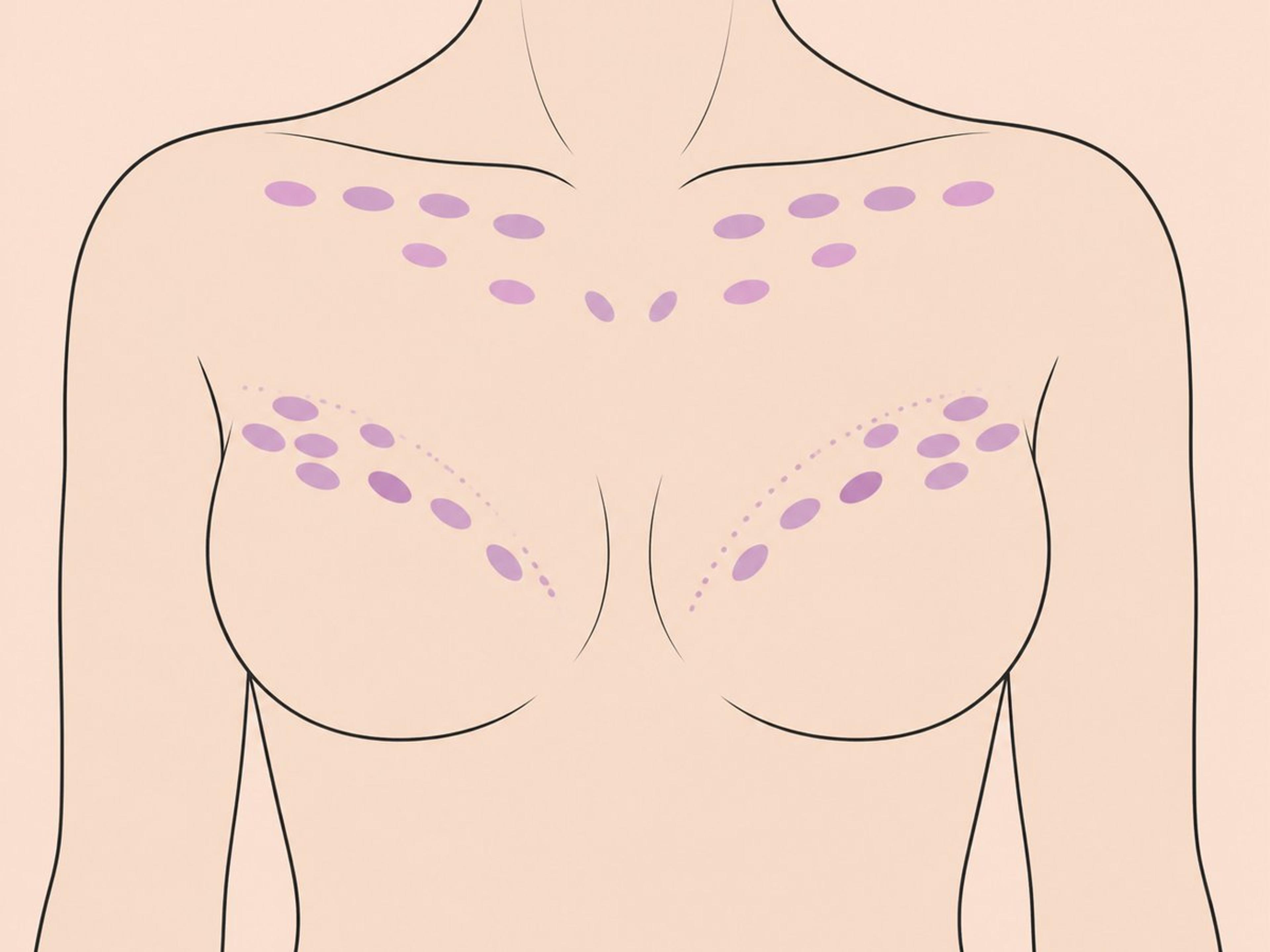
Fat is taken from areas such as the abdomen, flanks or thighs, then carefully prepared and placed in small amounts throughout the breast. This can add a moderate amount of volume — usually up to around one cup size — and restore fullness in the upper breast and décolletage. Using small amounts helps the transferred fat settle and develop its own blood supply.
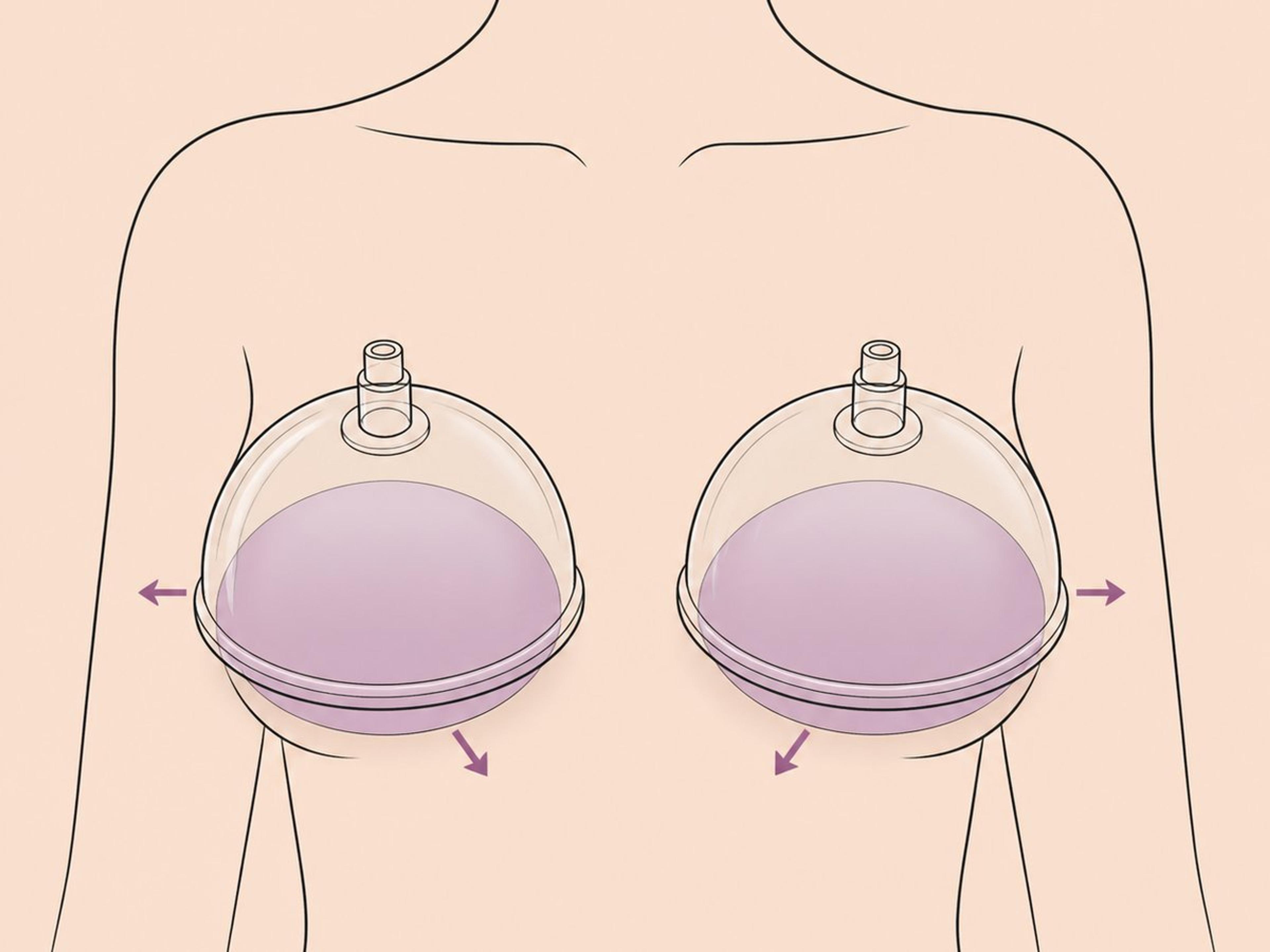
For some patients, an external suction device may be worn over the breasts for several weeks before surgery. It gently stretches the skin and creates more space for the transferred fat. It can allow more fat to be placed in one session, but it must be worn for long periods each day and can be uncomfortable or irritate the skin.
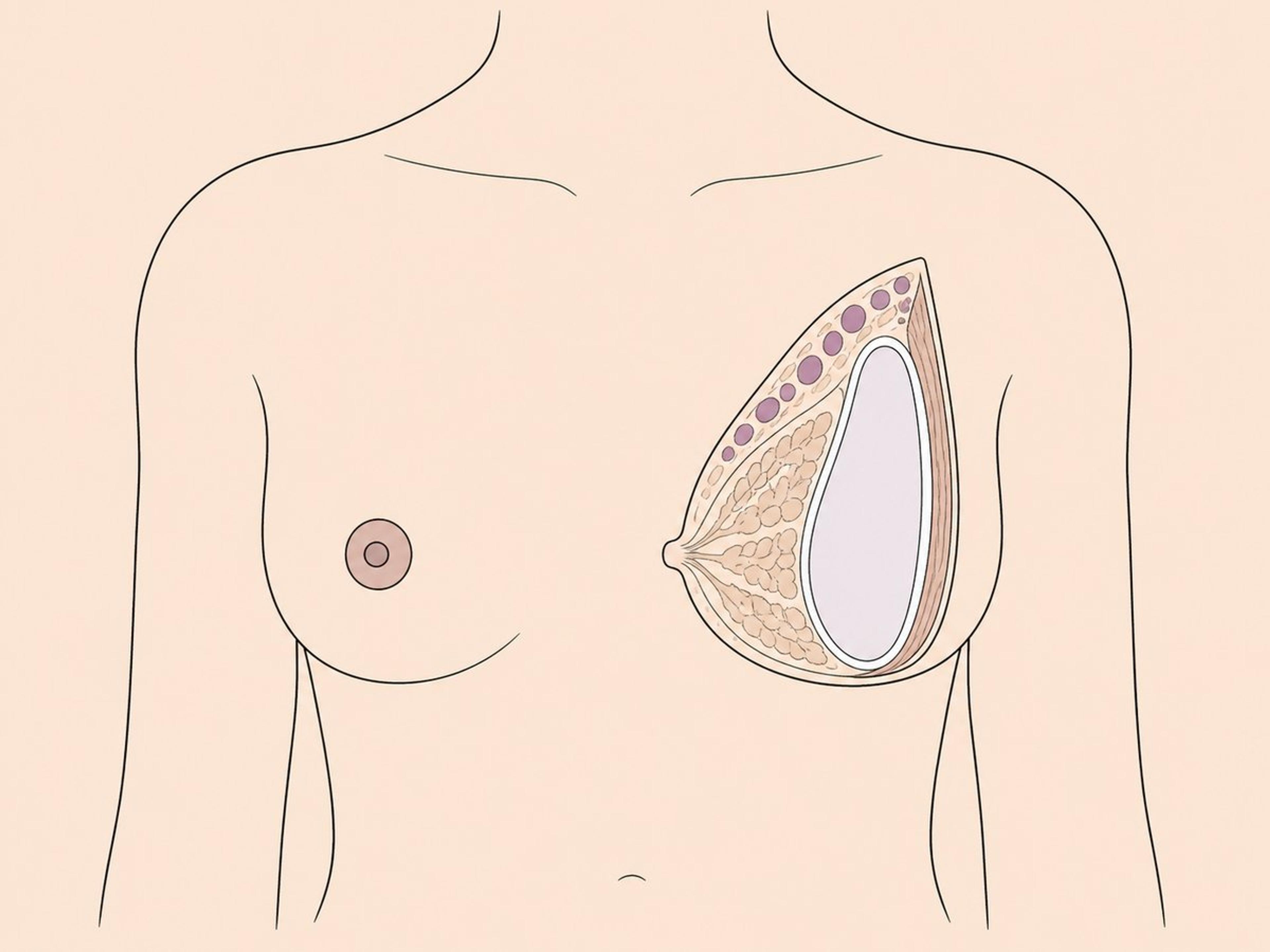
An implant can provide more volume and projection, while a layer of your own fat softens its edges and smooths the upper and inner breast. This can suit people with little natural breast tissue over an implant who want a softer transition. It combines the volume of an implant with the subtle contouring possible with fat transfer.
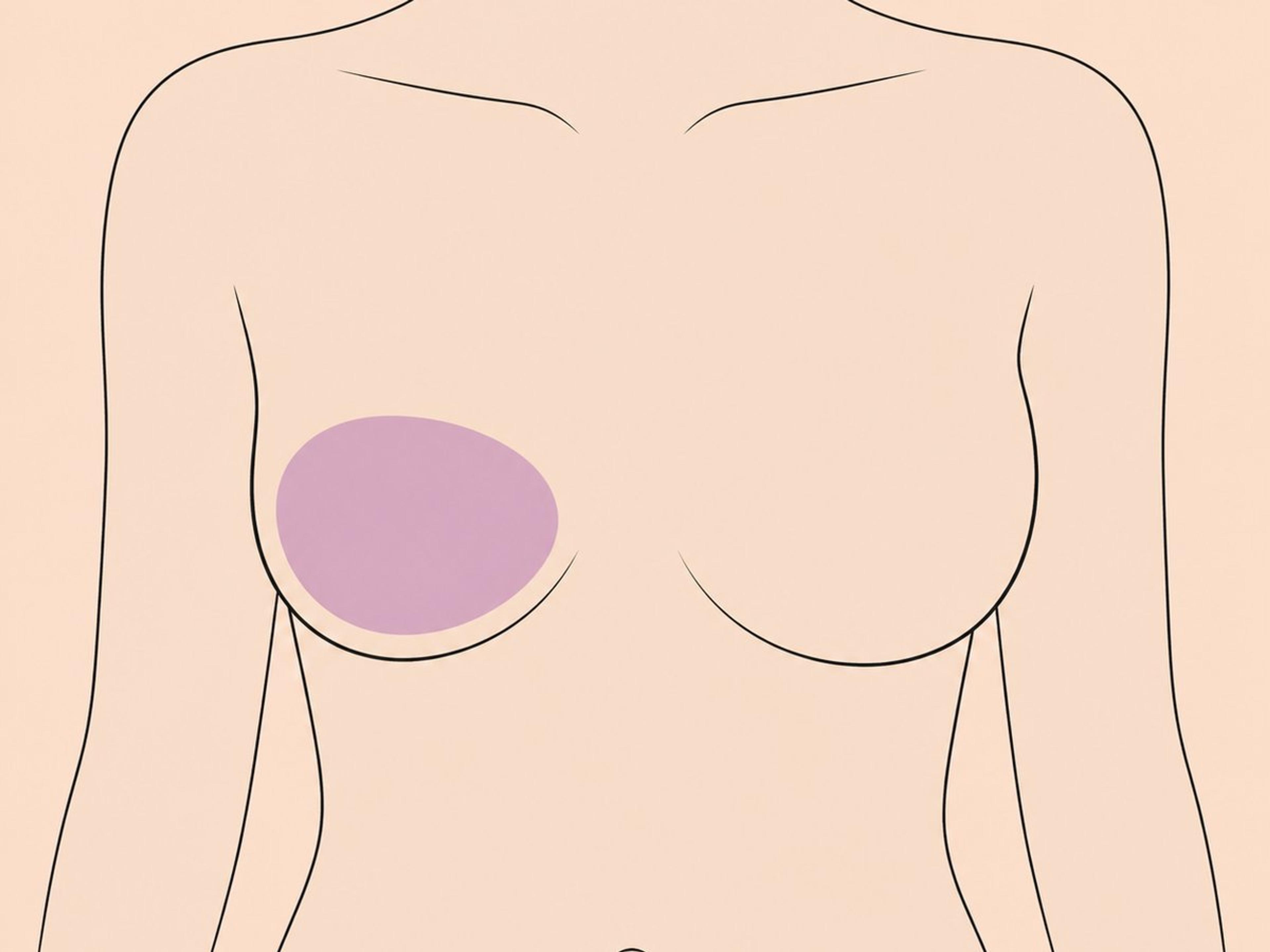
Fat transfer can be combined with a breast lift to improve uneven breasts or tuberous breast shape. It allows the surgeon to add volume where it is needed and balance the lower breast folds more precisely. Some corrections need more than one stage, depending on the breast shape, skin and available donor fat.
The operation, step by step
Marking, then anaesthesia
The breasts and the donor areas are marked while you are standing, because both change shape the moment you lie down and the graft has to be placed against the shape you will actually see in a mirror. You are then asleep under general anaesthesia for the whole of it — harvest and grafting happen in one sitting.
Harvesting the fat
Fat is drawn from the abdomen, flanks or thighs through blunt cannulas at low negative pressure, because aggressive suction ruptures the very cells the result depends on. The donor site is chosen for contour as much as for yield — the liposuction is half of what you see afterwards, not just a way of collecting material.
Processing the graft
The aspirate is separated into viable fat, oil, blood and tumescent fluid, and only the fat layer is injected. The rest would add volume that vanishes within days while raising the risk of oil cysts and inflammation.
Injecting in fine passes
The fat is laid down as many small ribbons across several planes — under the skin, around and behind the gland — rather than as one pocket, so every parcel sits within reach of a blood supply and survives. We deliberately overfill, because close to 40 percent of the injected volume is reabsorbed before the result settles.
Compression, then one night at the clinic
No suction drains are used: soft compression over the breasts and a garment over the donor sites do that work while limiting bruising and swelling. You stay one night so that pain control, the donor sites and the first dressing change are handled by the team rather than by you in a hotel room.
Breast fat transfer: recovery week by week
- Day 1
You stay with us one night. The donor sites are usually sorer than the breasts — a burning, bruised soreness — and you wear a compression garment over them and a soft, non-wired or sports bra over the breasts. Light walking is encouraged. No driving, no lifting.
- Week 1
Swelling and bruising are at their worst, at the breasts and the donor sites both. Most people manage desk-based work within a few days and are moving gently by day 3 or 4. The breasts look fuller now than they will — that is oedema, not the result.
- Week 3
Bruising has largely settled and most day-to-day activity is comfortable. Compression on the donor site usually continues to around 4 to 6 weeks, and running, heavy lifting and strenuous exercise wait until about a month. Firm areas within the breast are common at this stage while the graft consolidates.
- Month 3
The bulk of resorption has happened — on average a little under half the injected volume is lost, and this is the window it goes in. This is the usual point for review, in person or by video, and for deciding together whether you want a second grafting session. Some residual swelling may still be present.
- Month 6
The fat that survived has its own blood supply and is considered permanent. It behaves like the rest of your breast tissue and will change if your weight changes. Shape and volume are stable enough to judge the final result, and any planned touch-up grafting is done from this point onward.
Breast fat transfer: how to prepare
- Have baseline breast imaging done and documented before surgery. We advise screening mammography from age 40, and earlier if you have a family history of breast cancer or dense or cystic breasts, so any change afterwards can be read against a known starting point.
- Stop smoking and every form of nicotine at least 4 weeks before surgery. Nicotine impairs the blood supply the graft depends on to survive, and raises both infection and fat-loss rates.
- Hold your weight steady and do not actively diet in the weeks before or after surgery. Grafted fat behaves like the fat it came from, so losing weight afterwards reduces the result.
- Confirm with your surgeon that there is enough fat at the intended harvest sites, and agree what a one to two cup size increase actually looks like on you — including the possibility of a second session.
- Arrange a compression garment for the donor site to wear for 4 to 6 weeks and a soft, non-wired or sports bra for the first 2 weeks, and stop blood-thinning medication and supplements as directed.
Breast fat transfer: risks
Every operation carries risk. We name them so you can ask the right questions.
- Fat necrosis and oil cyst formation, reported in roughly 3 to 15 percent of patients, presenting as firm lumps you can feel that may need imaging to characterise
- Unpredictable partial resorption of the graft — which frequently means a repeat session to reach the size you wanted
- Infection at the breast or at the liposuction donor site, with elevated risk in smokers and in people with diabetes
- Haematoma, prolonged induration and persistent temporary pain,
- Donor-site contour irregularity, dimpling, prolonged numbness or asymmetry from the liposuction component

Breast fat transfer in Turkey: what to expect
Coming to Turkey adds one thing the operation itself does not: distance. What follows is the travel half of the plan — how long to stay, what you leave holding, and who answers the phone once you are home.
Before you fly
Talk to the surgeon who will operate, not to a coordinator, and do it before you book anything. Two things are worth settling in writing: whether a second grafting session is priced into your package or billed separately, and who manages a late seroma, infection or palpable nodule once you are home. Build the calendar backwards from the final wound check rather than forwards from the operating date, and book a flexible return fare — it costs less than rebooking a fixed one.
At the clinic
Surgery is under general anaesthesia and you stay one night. This is two operations in one sitting — liposuction to harvest, then grafting — and it is generally done without suction drains; soft or elastic compression over the breast does that work instead. Ask which building your operation takes place in, and ask your surgeon for their own numbers.
Recovery in Istanbul
Plan 7 days in Istanbul — one inpatient night and 6 hotel nights — with 2 follow-up visits: a wound and donor-site review at around day 2 or 3, and a final review at day 6 or 7 that clears you to fly. Plan those days around the donor sites rather than the breasts. The liposuction areas dominate the first week, the compression garment goes over them, and the middle stretch is deliberately low-activity. Bring loose clothes and expect to rest rather than sightsee.
Heading home
We prefer you to fly at 7-8 days; 6 is the earliest. UK practice commonly advises avoiding flights over 4 hours for about 4 weeks after an operation, so take that seriously even when your wounds look fine: aisle seat, up on your feet every hour, calf exercises, and the donor-site garment on through the flight. Volume is not final when you board. Care continues for twelve months.
Checking a clinic in Turkey
Turkey rewrote its medical-tourism rules on 26 April 2025, replacing the 2017 regulation. Any facility treating international patients must now hold an international health tourism authorisation certificate, register on the Ministry of Health's HealthTürkiye portal, and carry complication insurance for the procedures it performs; hospitals and medical centres also had to complete TÜSKA accreditation by the end of that year. Facilities are required to publish that certification — so you can check ours, and you should check anyone else's before you pay a deposit.
Breast work is the area where a decision made in an afternoon is lived with for a decade, so press on the parts a brochure skips. Ask whether you are operated on in a hospital or a day unit and whether there is a bed for the night; ask for the named surgeon and their Turkish Medical Association registration; and ask what is written down if you need a revision after you have flown home. Where implants are involved, leave with their batch details in writing — they are what any surgeon anywhere will need later.
Most nationalities enter Turkey visa-free or on an e-Visa for a stay of this length, with a passport valid at least six months. Confirm the rule for your own passport, and build the return flight around the last clinic visit rather than fixing it in advance.
- United Kingdom
- £6,000 – £10,000
- United States
- $8,000 – $12,000
Published typical ranges for orientation — confirm with a local quote.
Breast fat transfer: frequently asked questions
How much bigger will my breasts actually get?
Fat transfer generally achieves about a one to two cup size increase. It is a volume-limited technique — how much fat the breast can support in one session is constrained by the recipient space available and by blood supply. If you want a large increase, implants or a staged series of grafting sessions will serve you better, and we will tell you that at consultation rather than after.
How much of the transferred fat survives long term?
Pooled data from systematic review report mean volume retention of about 62 percent, with individual studies ranging from roughly 45 to 83 percent. Most of the resorption happens in the first 3 months; after that the surviving fat is revascularised and considered permanent. We compensate by deliberately overfilling at the time of surgery.
Will I need more than one procedure?
Often, yes. Because resorption varies between people and single-session volume is limited, a touch-up or staged session is common and should be planned for as an expected part of the pathway, not treated as a complication. Any second session is normally scheduled once volume has stabilised at around 3 to 6 months.
Does fat transfer to the breast interfere with mammograms or breast cancer screening?
Fat grafting can produce oil cysts and calcifications that show on mammography, and these appear in a meaningful minority of patients. Radiologists experienced in breast imaging can usually distinguish post-grafting change from a suspicious finding, but always tell the radiography team you have had lipomodelling — imaging is normally deferred for around 6 months after surgery. Routine screening continues on its normal schedule.
Does fat transfer to the breast increase the risk of breast cancer?
A meta-analysis of 15 observational studies covering 8,541 participants found no difference in overall survival, disease-free survival or local recurrence between patients who had autologous fat grafting and controls. Current evidence therefore does not show an increased oncological risk. It does not remove the need for age-appropriate screening either.
How does fat transfer compare with implants?
Fat transfer avoids implant-specific problems — rupture, capsular contracture, replacement over time, BIA-ALCL — and it contours the donor area at the same time. The trade-offs are a smaller and less predictable volume gain, the likelihood of repeat sessions, and graft-specific issues such as fat necrosis and calcification. Composite augmentation uses both: an implant for volume, fat for contour.
How soon can I fly home after fat transfer breast augmentation?
The earliest is 6 days and we would rather you flew at 7. That window is set by wound and donor-site review, not by an absence of clotting risk — the CDC puts symptomatic venous thromboembolism at roughly 1 in 4,600 flights longer than 4 hours and lists recent surgery among the factors that raise it.
What does it cost in the United States?
The American Society of Plastic Surgeons reports an average surgeon fee of $5,719 for breast augmentation with fat grafting only, against $4,875 for implant-based augmentation. That is the surgeon's fee alone and excludes anaesthesia, facility and operating-room charges, imaging, garments and medication, so the real total is materially higher. The 2024 ASPS release stopped publishing a single average and gives a projected surgeon-fee range of $5,500 to $9,500 instead.
Who is not a good candidate for fat transfer to the breast?
The clear exclusions are pregnancy or breastfeeding, an active infection anywhere in the body, an unresolved breast finding — a lump or an abnormal scan that has not been fully worked up — uncontrolled diabetes, and a bleeding or clotting disorder that cannot be managed around surgery. This operation then adds its own filters: you need enough donor fat to harvest, which very lean patients often do not have; a stable weight, because grafted fat shrinks and grows with you; and no nicotine in any form, because nicotine constricts the blood supply the graft depends on to survive. A strong family history of breast cancer does not rule you out, but it moves the imaging and screening conversation to the start of the consultation rather than the end.
Which symptoms after surgery mean I should contact the clinic straight away?
Contact us the same day for spreading redness or warmth at the breast or a liposuction site, discharge from a wound, fever above 38 °C, pain that worsens after the first days instead of easing, or one breast that suddenly swells and feels tight and hard — that can be a haematoma and is assessed urgently. Go straight to an emergency department for a swollen or painful calf, breathlessness or chest pain: after surgery and a long flight these can signal a blood clot, and they are an emergency rather than a message to us. Firm lumps that appear gradually over weeks are usually fat necrosis and belong in a routine review — but if you are unsure which category a symptom falls into, send the photograph. We would rather look at ten images of normal healing than miss one infection.
Will the result change if my weight changes — and does the liposuction count as weight loss?
Both halves of this question have the same answer: the fat keeps behaving like fat. Grafted fat keeps the metabolic character of the site it came from, so if you lose weight the breasts shrink with you — sometimes first, if the donor area is where your body draws from — and if you gain, they grow, occasionally out of proportion. And the liposuction that harvests the graft is contouring, not weight loss: the volume removed is modest and will not move the number on the scale. A stable weight is what qualified you for the operation, and it is also what protects the result.
Will fat transfer lift breasts that have started to sag?
No, and this is the commonest misunderstanding we correct at consultation. Grafting adds volume; it does not raise the nipple or shorten the skin envelope, and adding weight to a breast that already sits low can make the droop marginally more pronounced rather than less. What fat does well is restore fullness in the upper pole, which reads as a lifted look while the nipple is still sitting above the inframammary crease. Once the nipple has dropped to or below that crease, the operation that corrects it is a breast lift — with or without grafting at the same time — and we will tell you that rather than sell you the smaller procedure.
How much does breast fat transfer cost in Turkey?
€1,100 to €4,500 with us, confirmed after a consultation rather than quoted blind. For comparison it is typically £6,000 – £10,000 in the United Kingdom and $8,000 – $12,000 in the United States. The spread is wide because it depends on how many donor areas have to be harvested and whether one session is planned or two. Fat partly reabsorbs, and an honest result often needs a second round.
Sources
- [1]Updated guidelines for lipomodelling of the breast (BAPRAS, BAAPS and Association of Breast Surgery joint guidance) · British Association of Plastic, Reconstructive and Aesthetic Surgeons (bapras.org.uk) · 2021
- [2]Fat Transfer Breast Augmentation Risks and Safety · American Society of Plastic Surgeons · 2025
- [3]A Systematic Review of the Literature and Meta-Analysis of Autologous Fat Transfer: Fat Transfer Confers a 4.2% Incidence of Complications · Cureus (via PubMed Central, NLM) · 2025
- [4]Autologous Fat Grafting in Cosmetic Breast Augmentation: A Systematic Review on Radiological Safety, Complications, Volume Retention, and Patient/Surgeon Satisfaction · Aesthetic Surgery Journal (PubMed / NLM) · 2016
- [5]The oncological safety of autologous fat grafting: a systematic review and meta-analysis · BMC Cancer (PMC / NLM) · 2022