


Pectoral implants: what it is
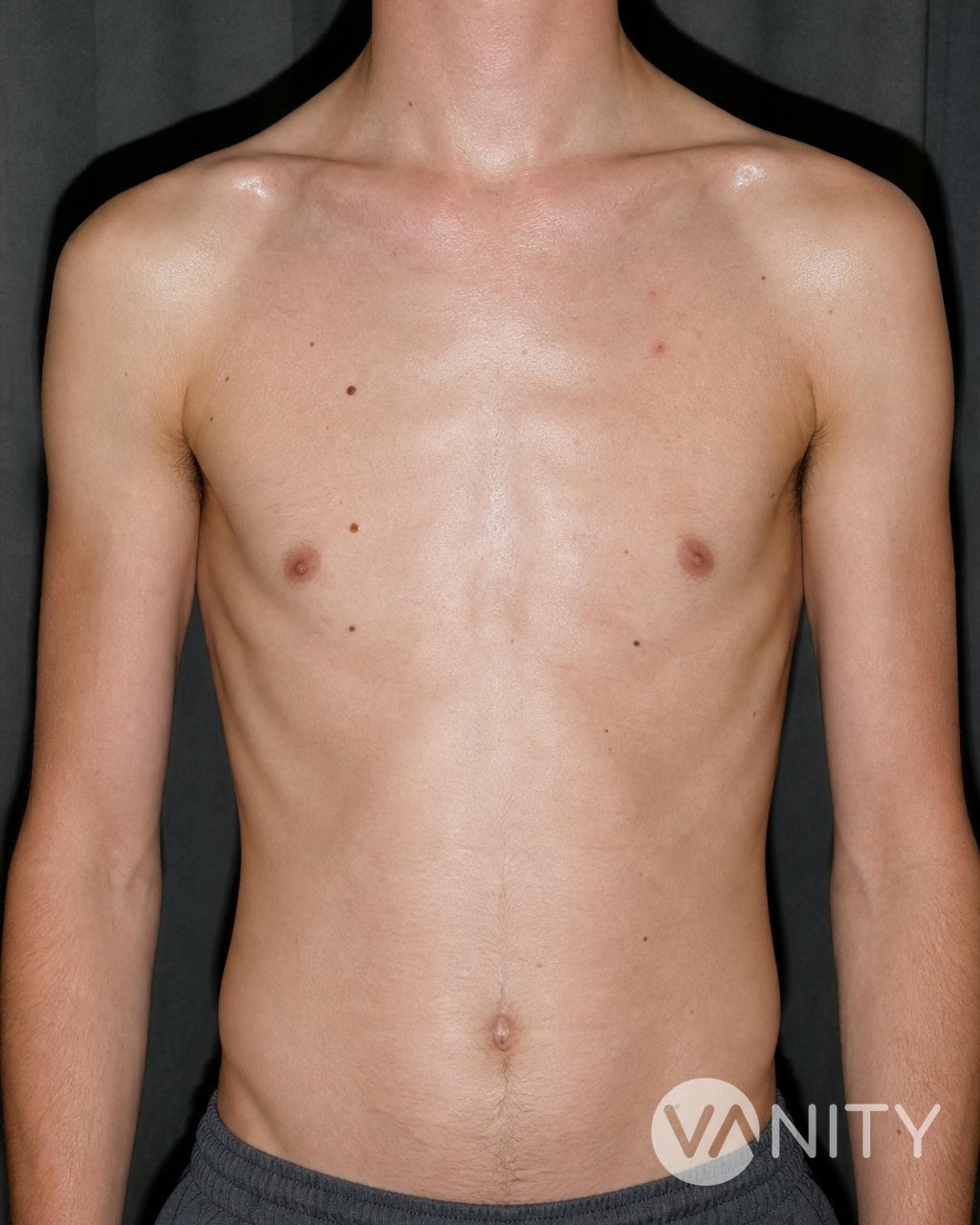
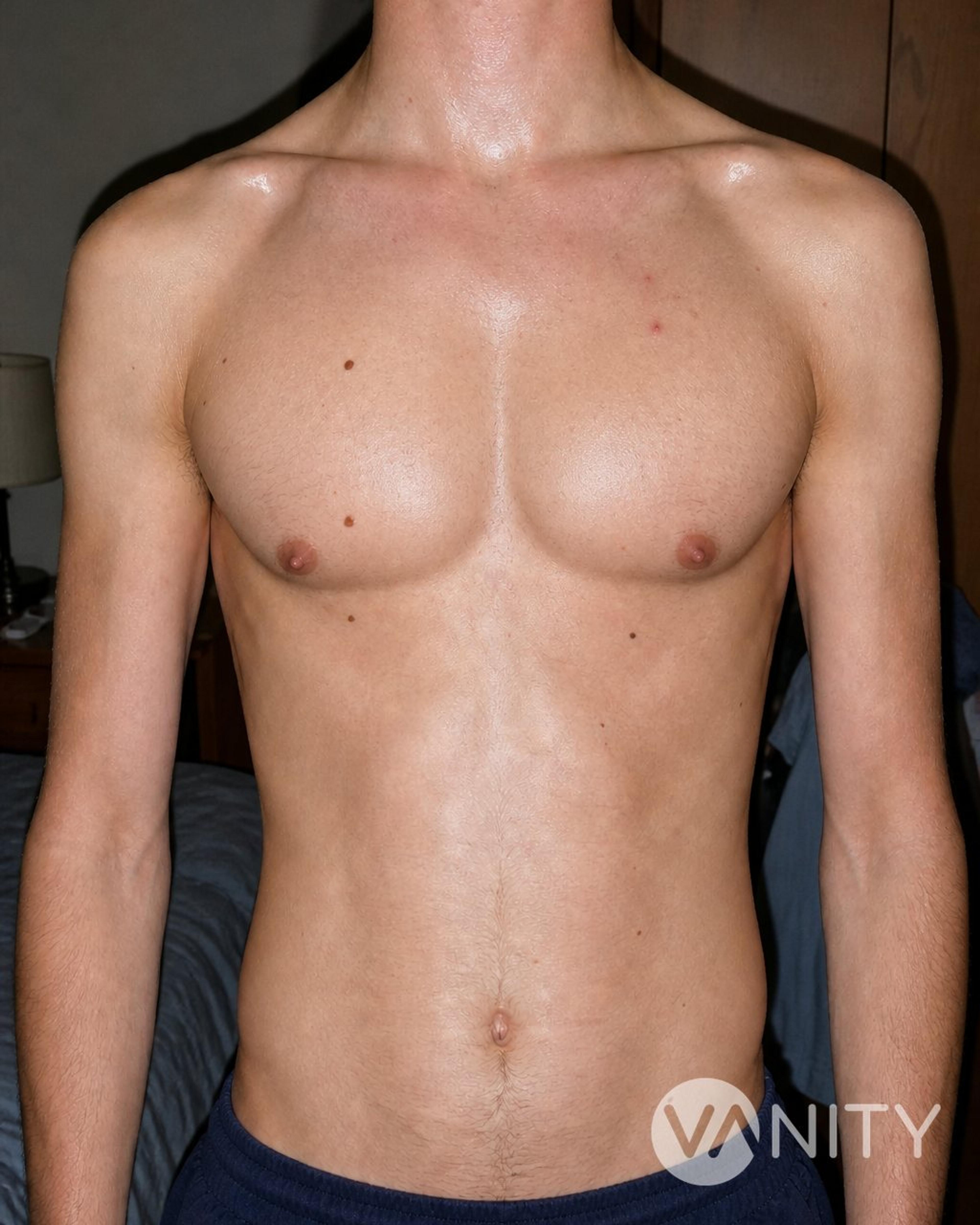
A pectoral implant is a solid or cohesive silicone prosthesis placed through a small incision in the armpit into a pocket beneath the pectoralis major. Sitting behind the muscle, its edges stay covered by muscle and fascia, and it adds width across the upper chest with projection at the breastbone and under the collarbone. The device is chosen — or cast to order — from measurements taken standing: width at the lower and infraclavicular borders, muscle height, and the distance from the chondrosternal angle to the armpit. The pocket is then cut roughly 2 cm smaller than the implant, so the implant is held rather than free to travel.
It is done mainly in men who want more chest bulk than training produces, and in chests where muscle is absent, underdeveloped, wasted or damaged — Poland syndrome, post-traumatic and post-surgical defects among them. It is also used in chest masculinisation for transgender men, and combined with gynaecomastia correction or chest liposculpture when glandular tissue or fat is the larger part of the problem. Where the wish comes from muscle dysmorphia, body dysmorphic disorder, or an expectation surgery cannot meet, we say so at consultation and do not operate.
Pectoral implants: techniques we use
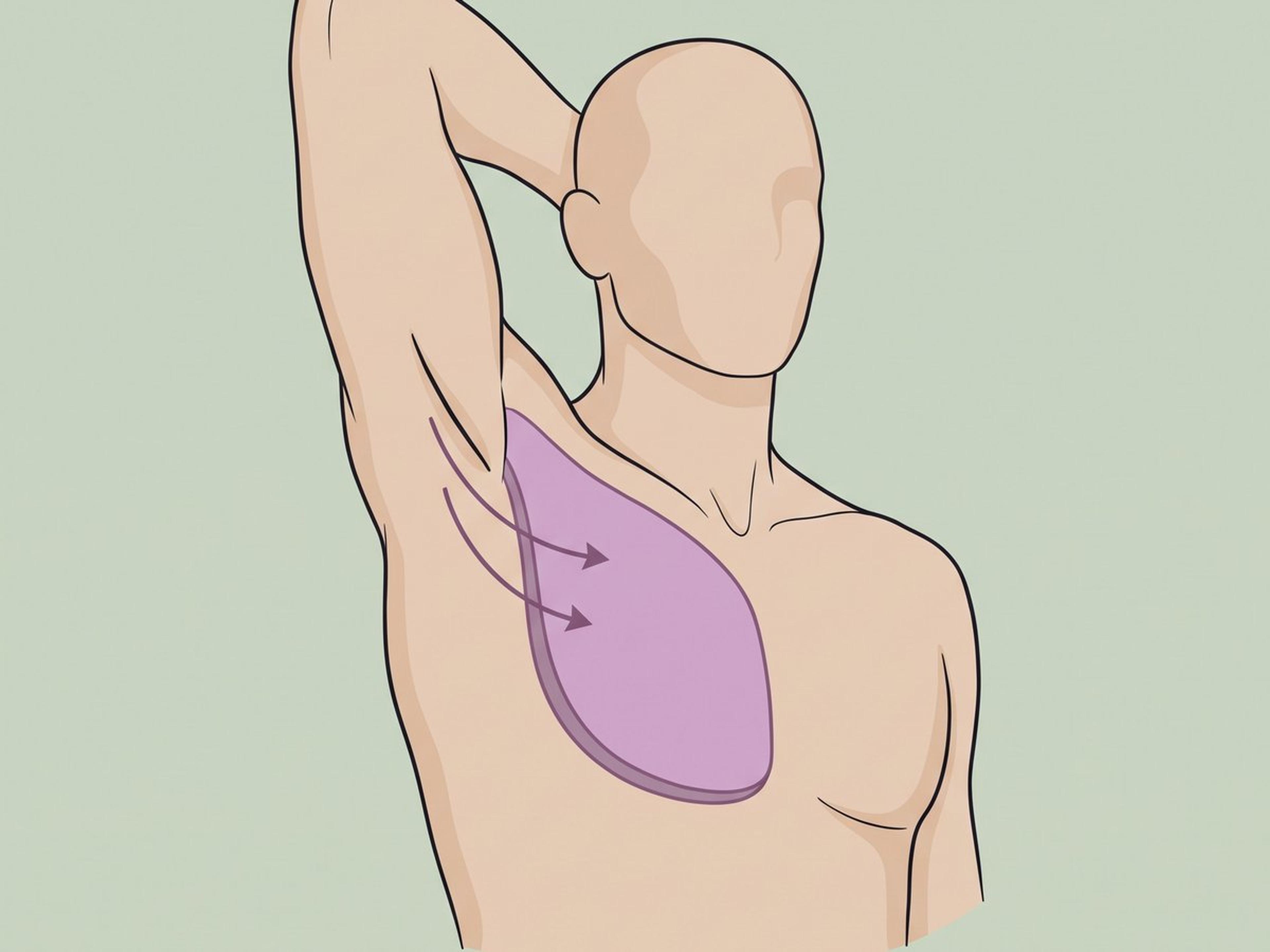
The standard approach is a curved incision of 4.5 to 6 cm hidden in a crease of the armpit, through which sharp and then blunt dissection opens a pocket deep to the pectoralis major. Dissection is held to within 1 to 2 cm below the areola, because going lower gives a feminised lower pole. You are sat upright on the table before closure so symmetry can be judged in the position you will actually stand in; bleeding is controlled meticulously, the pocket is irrigated with antibiotic or povidone-iodine solution, and drains are generally not used.
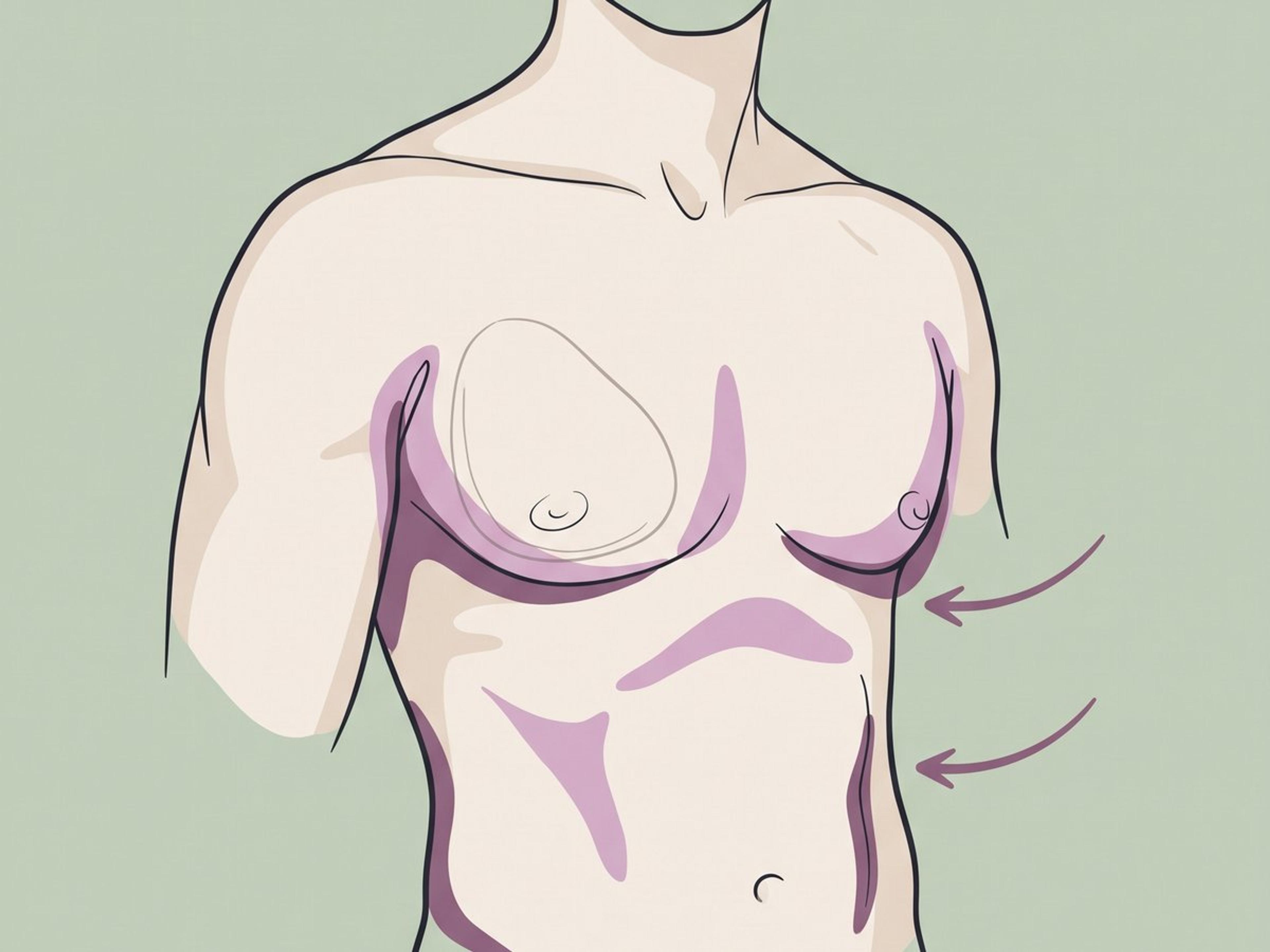
Implant placement is often combined with liposuction of the chest, axillary fold and upper abdomen, or with selective fat grafting, so the implant supplies volume while surface contouring defines the pectoral borders. This suits a chest that lacks both bulk and definition, and chests with coexisting gynaecomastia or pseudogynaecomastia. If what is missing is definition rather than volume, fat-based contouring alone is the honest alternative — no implanted device, no implant complications.
The operation, step by step
Measuring and marking, standing
Chest width at the lower and infraclavicular borders, muscle height and the chondrosternal-angle-to-armpit distance are taken with you upright, because that is the only position in which the implant size and the pocket limits mean anything. The marks made here decide how far the dissection may run, and they are drawn before you are anaesthetised.
General anaesthesia with a pectoral nerve block
The operation is done asleep, and a medial and lateral pectoral nerve block is added so you wake with the chest already covered rather than chasing the pain afterwards. Antibiotic prophylaxis is given before the incision, not after it, because the pocket will hold an implanted device.
Armpit incision and submuscular pocket
A curved incision of 4.5 to 6 cm in a natural crease of the armpit keeps the scar off the chest entirely. Sharp then blunt dissection opens a pocket deep to the pectoralis major, cut roughly 2 cm smaller than the measured implant so the device is held rather than free to travel, and stopped within 1 to 2 cm below the areola — going lower is what produces a feminised lower pole.
Implant placed, symmetry judged upright
The implant is passed through the armpit opening and seated under the muscle, the pocket is irrigated with antibiotic or povidone-iodine solution and bleeding controlled meticulously. You are then sat upright on the table before anything is closed, so symmetry is confirmed in the position you will actually stand in rather than lying flat.
Closure, compression and one night in
The armpit incisions are closed in layers and drains are generally not used. A light compressive dressing or vest goes on before you wake, and your arms are deliberately restricted from the first hour — the pocket has not healed and the implant can still shift. You stay 1 night.
Pectoral implants: recovery week by week
- Day 1
Surgery is under general anaesthesia, usually with a medial and lateral pectoral nerve block for pain control. You wake with marked chest tightness and limited arm elevation, and a light compressive dressing or vest over the chest. Drains are typically not placed. You stay 1 night.
- Week 1
Swelling and bruising peak, then begin to settle; the armpit incisions are kept dry and reviewed. Reaching overhead, pushing and lifting are all restricted — the pocket has not healed and the implant can still shift. Sedentary work is usually possible toward the end of this week.
- Week 4
The compressive dressing is generally worn for about a month and is then discontinued, and mild activity comes back. Implant edges become less palpable as swelling resolves and the capsule matures. Chest and shoulder movement is close to normal.
- Month 2-3
Full upper-body resistance training is normally cleared in this window, at your surgeon's discretion. Some patients see the implant move when the pectoralis contracts — that is expected with submuscular placement, not a fault. Muscle spasm, if it persists, is treated with muscle relaxants or botulinum toxin.
- Month 6
The contour is considered settled and the armpit scars have started to fade and flatten. Asymmetry, malposition or capsular firmness still present at this point is assessed for revision rather than waited out. Long-term follow-up watches implant position and any new swelling.
Pectoral implants: how to prepare
- Consultation with a board-certified plastic surgeon, including standing chest measurements — width at the lower and infraclavicular borders, muscle height at mid-muscle, and chondrosternal angle to armpit — to select or cast the implant size
- An explicit conversation about what implant volume can and cannot do, with screening for muscle dysmorphia and body dysmorphic disorder; unrealistic expectations are a contraindication, not a detail to work around
- Stop nicotine in every form, and pause anticoagulants, NSAIDs and blood-thinning supplements on the schedule your surgeon gives you
- Tell us about any anabolic steroid or performance-enhancing drug use — this changes anaesthetic and bleeding risk, and we need the truth rather than the tidy version
- Anaesthesia review and clearance for general anaesthesia, with antibiotic prophylaxis planned before the incision
- Clip the underarm hair as directed, and arrange help at home for the first week with anything that means reaching overhead
Pectoral implants: risks
Every operation carries risk. We name them so you can ask the right questions.
- Bleeding and haematoma in the submuscular pocket, which may mean a return to theatre for evacuation
- Infection of the implant or the pocket, which can end in the implant being removed
- Implant displacement, rotation or asymmetry — a displaced implant can progress to skin thinning and near-extrusion, and has been documented on mammography and CT
- Capsular contracture and seroma; a late, persistent seroma around a pectoral implant has been reported as breast implant-associated anaplastic large cell lymphoma (BIA-ALCL) in a male patient, so fluid that appears years later is sent for cytology rather than watched
- Implant rupture or deflation, requiring exchange
- Nerve-related problems: numbness or altered sensation in the inner arm, and pectoralis spasm; dissecting between pectoralis major and minor risks partial denervation of the pectoralis major
- A poor aesthetic result — visible or palpable implant edges, or an unnatural lower pole if the pocket is dissected too low

Pectoral implants in Turkey: what to expect
Most patients who come to us for this operation are travelling, and the travel is the part that is usually under-planned. Below is what the pathway actually looks like in Turkey — including the parts that continue after you have gone home.
Before you fly
Talk to the surgeon who will operate, before you book anything — video is fine, but the conversation should be with the surgeon, not only with a coordinator. Send standing photographs and, where possible, your measurements, so implant size and whether a custom cast is needed are settled before you land rather than on the morning of surgery. If an agency or facilitator is arranging the trip, establish in writing who holds clinical responsibility; studies of patients travelling to Turkey describe facilitators handling transfers, accommodation and records while the surgeon follows up remotely afterwards, which is useful but is not the same as a named surgeon who will examine you.
At the clinic
The operation is done under general anaesthesia, usually with a medial and lateral pectoral nerve block so you wake with the chest already covered for pain. The pocket is opened through the armpit crease, the implant placed beneath the pectoralis major, and you are sat upright on the table so symmetry is confirmed in a standing position before anything is closed. Drains are typically not used. You stay 1 night, and you leave in a light compressive dressing or vest, with your arms deliberately restricted.
Recovery in Istanbul
Plan on 7-8 days in the city in total . The first days are chest tightness and limited arm elevation rather than pain; swelling and bruising peak early in the week and then start to settle, and the armpit incisions are kept dry and reviewed at each visit. Sedentary work is usually manageable toward the end of the first week. Book a hotel room you can rest in, not a schedule you have to keep.
Heading home
We ask you to fly on day 7-8 where the itinerary allows it. Surgery and long-haul flying each raise the risk of deep vein thrombosis and pulmonary embolism so plan the flight for that risk and not for comfort: aisle seat, calf exercises in the seat, walk the cabin, drink water. Do not carry your own case — a luggage strap and the reach into an overhead bin both load an armpit incision of 4.5 to 6 cm directly.
- United Kingdom
- £5,000 – £9,000
- United States
- $8,000 – $12,000
- Western Europe
- €5,000 – €9,000
Published typical ranges for orientation — confirm with a local quote.
Pectoral implants: frequently asked questions
Where is the scar from pectoral implants?
The standard incision is a curved cut of 4.5 to 6 cm placed in a natural crease of the armpit, so there is no scar on the chest itself. The implant is passed through that opening into the pocket beneath the pectoralis major. With the arm down the scar is concealed, and it typically fades over 6 to 12 months.
Can you lift weights and train the chest after pectoral implants?
Yes — full upper-body resistance training is usually cleared 2 to 3 months after surgery, once the pocket has healed and compression has been stopped. Because the implant sits under the muscle, it can visibly move when the pectoralis contracts. Muscle spasm that persists after surgery is treatable with muscle relaxants or botulinum toxin.
Do pectoral implants look fake?
Naturalness comes from implant selection and pocket control rather than size alone: the pocket is cut about 2 cm smaller than the measured implant, and dissection is held to within 1 to 2 cm below the areola so the lower pole does not read as feminised. Anatomically shaped implants that follow the fan of the pectoralis major are reported to give a more natural silhouette than round devices. An implant oversized for the frame is the usual reason a chest looks operated on.
How long do pectoral implants last?
Solid and cohesive silicone pectoral implants have no expiry date and are not replaced on a schedule. They are revised or exchanged when something specific happens — displacement, rotation, rupture, capsular contracture or infection. New, persistent swelling or a fluid collection years later should be investigated, not observed.
Pectoral implants or fat grafting — which is better?
Implants add discrete volume and projection, and are the established answer when the muscle underneath is small, wasted or congenitally absent. Fat grafting and liposculpture reshape and define a chest that already has bulk, without an implanted device, and the two are often combined so volume and definition are handled together. The choice turns on how much bulk is genuinely missing versus how much definition is simply buried under fat.
Are pectoral implants used for Poland syndrome or chest masculinisation?
Yes. Partial or complete congenital absence of the pectoralis major, as in Poland syndrome, is a primary reconstructive indication, usually addressed with a custom implant cast to match the normal side. Pectoral implants have also been described alongside modified mastectomy in female-to-male chest surgery, following the same submuscular principles as the cosmetic operation.
Who is not a good candidate for pectoral implants?
Active infection anywhere in the body, uncontrolled diabetes and an unmanaged bleeding or clotting disorder each rule surgery out until they are resolved — a fresh submuscular pocket with a silicone device in it forgives none of them. Nicotine in every form has to stop beforehand, and blood thinners are paused on a schedule agreed with your prescriber. We also decline to operate where the wish is driven by muscle dysmorphia or body dysmorphic disorder, or where the expectation is one an implant cannot meet — that screening is part of the consultation, not a formality.
When should I contact the clinic after pectoral implant surgery?
Straight away — same day, not at the next scheduled visit — for spreading redness or warmth around the armpit incision, discharge from the wound, fever, or pain that worsens instead of easing: infection around an implant is treated urgently, not watched. One side suddenly swelling or feeling much tighter than the other suggests bleeding into the pocket and also needs to be seen that day. After the flight home, calf pain or unexplained breathlessness is an emergency, not a message to us. And months or years later, new persistent swelling or fluid around an implant should be reported and investigated rather than observed.
Will pectoral implants give me a trained, defined chest?
They give volume and projection — the bulk of a developed pectoralis — but not definition, and they add nothing to strength: the implant sits passively behind a muscle that works exactly as it did before. If the pectoral borders are buried under fat, the honest fix is liposculpture of the chest and axillary fold, alone or combined with the implant. An implant is a shape, not a shortcut past training or diet, and we say so at consultation when that is what is being asked of it.
How much does pectoral implants cost in Turkey?
€4,400 to €6,400 with us, confirmed after a consultation rather than quoted blind. For comparison it is typically £5,000 – £9,000 in the United Kingdom, $8,000 – $12,000 in the United States and €5,000 – €9,000 in Western Europe. Implant size and pocket position set the figure, along with whether liposuction is combined to define the border. The implant itself is a significant share of the cost.
Sources
- [1]Male Pectoral Implants: Radiographic Appearance of Complications · Journal of Radiology Case Reports (via PubMed) · 2016
- [2]Pectoral Implants · StatPearls, NCBI Bookshelf (NLM) · 2023
- [3]Breast Implant-Associated Anaplastic Large Cell Lymphoma: A Case Report about a Male Patient with Pectoral Implants · Breast Care (via PubMed) · 2024
- [4]Male chest enhancement: pectoral implants · Aesthetic Plastic Surgery (via PubMed) · 2008