
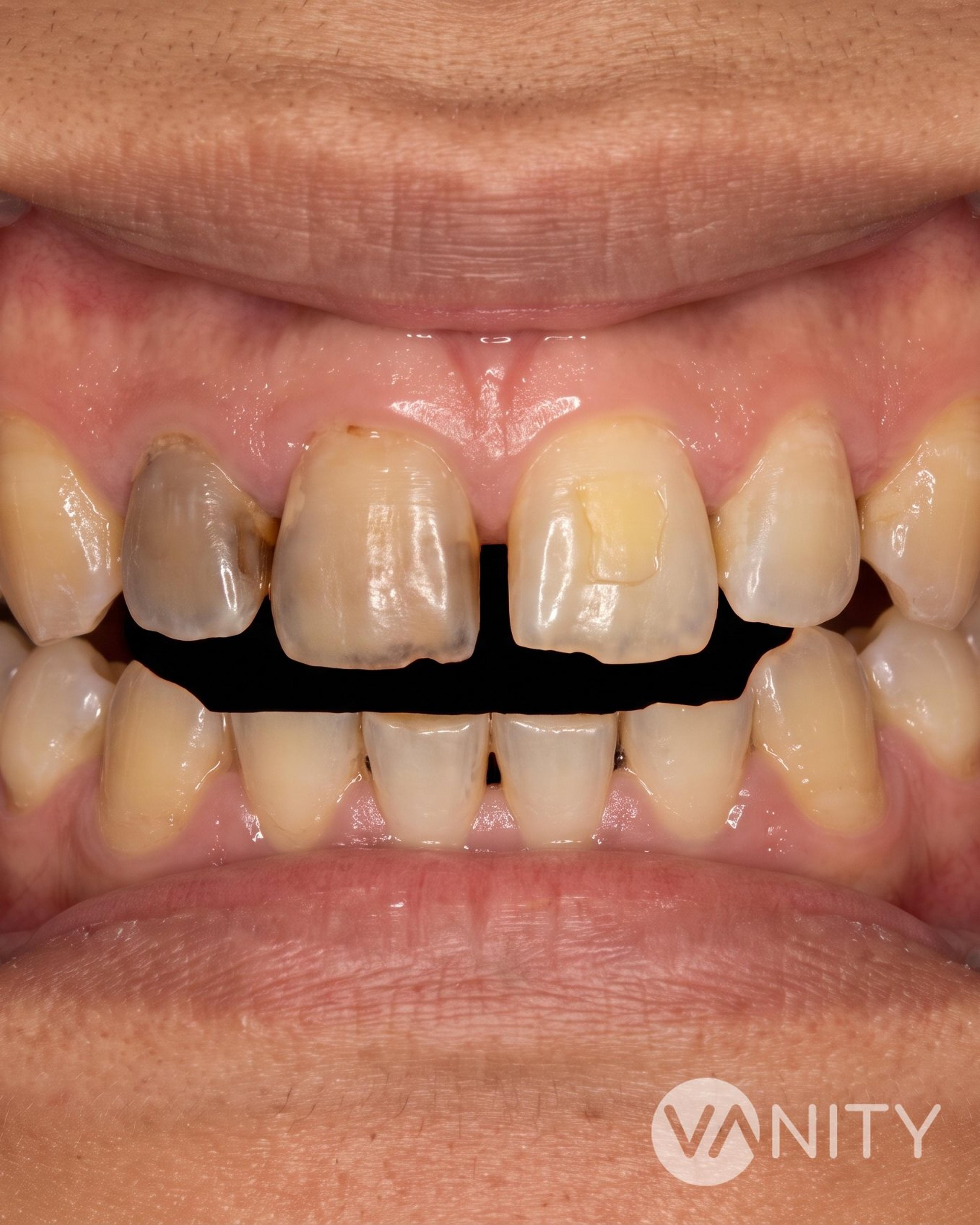
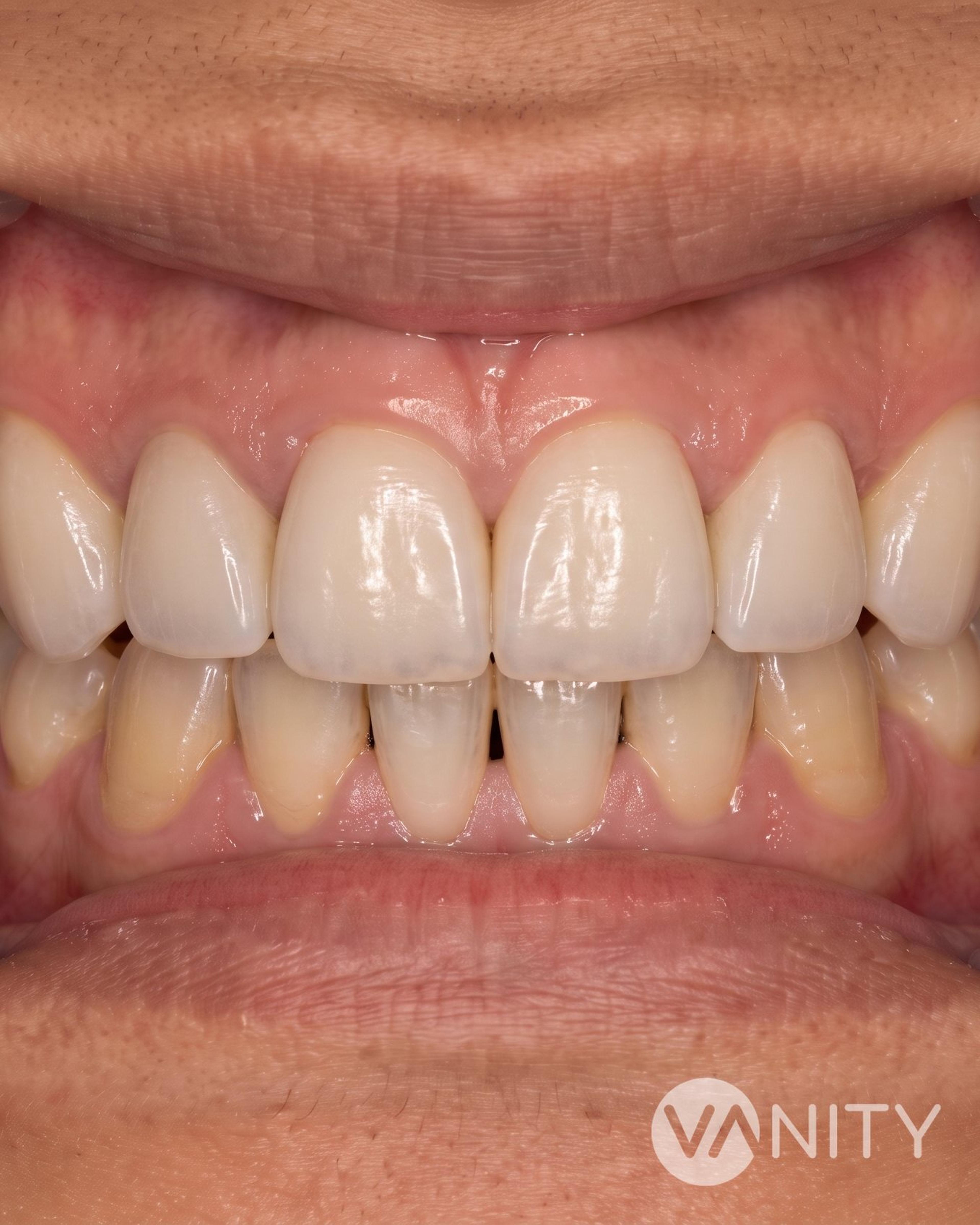

Dental veneers: what it is
A veneer is a thin facing bonded to the front of a tooth. It covers the visible surface only — a crown encases the whole tooth, and the difference decides how much enamel is removed. Ceramic veneers are made in a laboratory from a scan or impression and cemented with adhesive resin, while composite is sculpted onto the tooth in the chair and set with a curing light. The bond carries the restoration: where the preparation stays inside enamel, pooled survival in the literature is around 99%, falling to about 91% where dentin is substantially exposed.
Veneers suit discolouration that whitening will not shift, enamel defects, chips, worn incisal edges, small rotations and narrow gaps. They are not a treatment for unhealthy teeth — untreated decay and active periodontal disease have to be resolved first, because covering them makes the underlying problem harder to see rather than better. If you clench or grind, or your bite loads the upper front teeth heavily, you are a poorer candidate, and the occlusion is dealt with before any tooth is prepared, or the treatment does not proceed.
Dental veneers: techniques we use
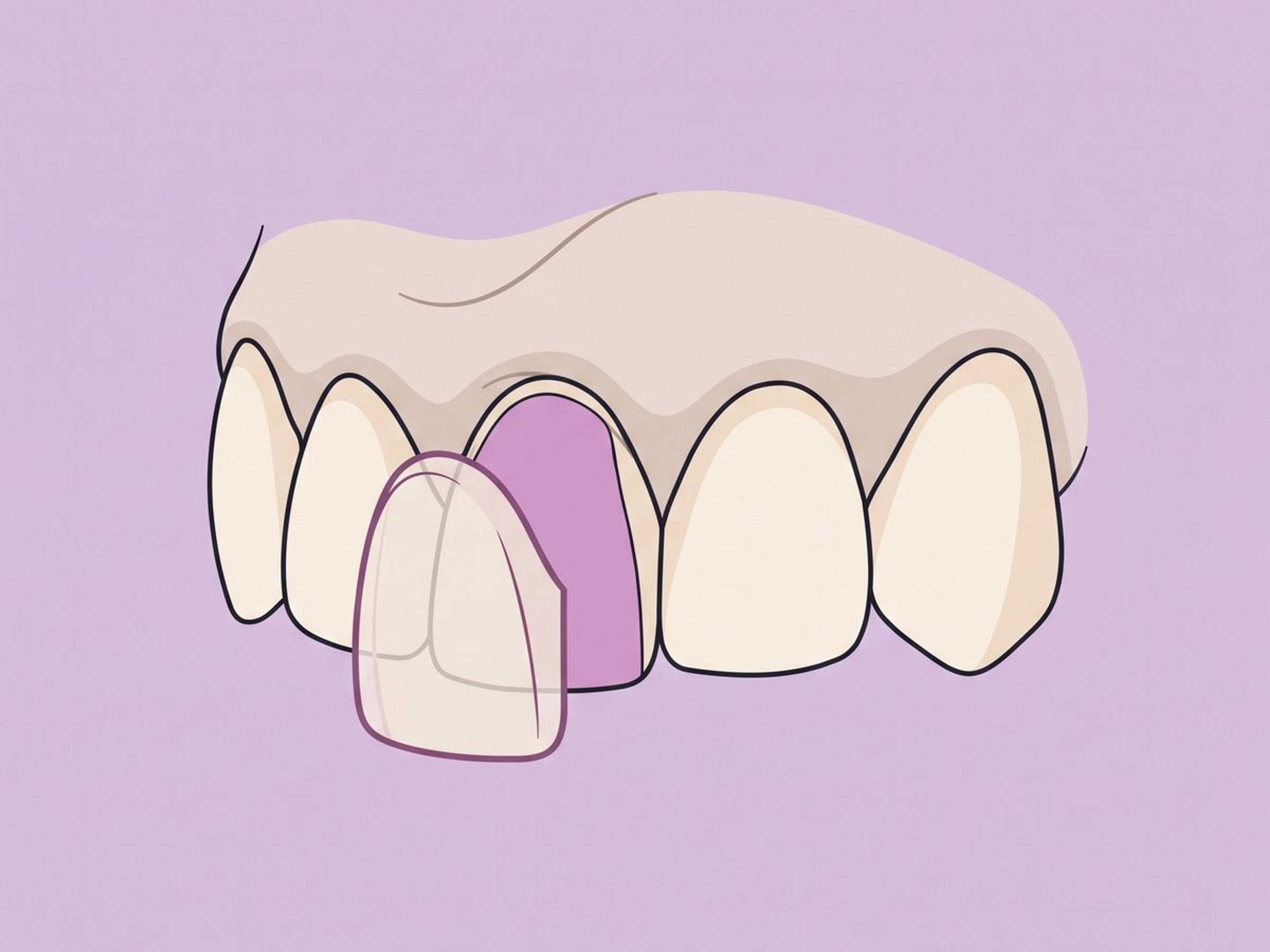
Ceramic hand-layered on a refractory die or platinum foil, which allows very thin sections and the highest optical fidelity of the materials in use. Pooled data across systematic reviews put survival around 96% at roughly 10 years. It carries more technical and aesthetic complications than pressed lithium disilicate — marginal staining and small chips in particular, with a pooled complication rate of 41.48% at a mean 10.4 years.
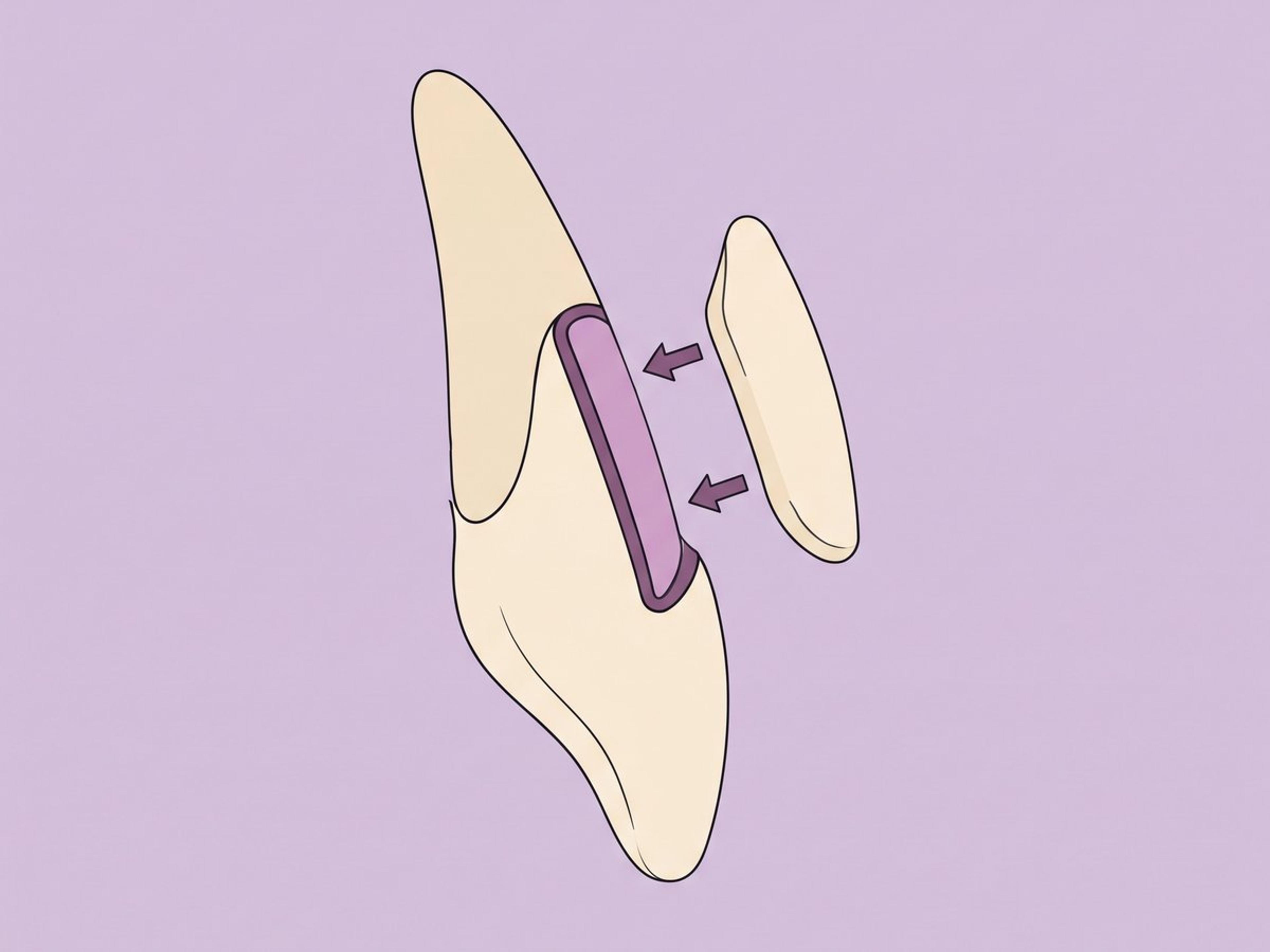
A higher-strength glass-ceramic pressed from ingots or milled from CAD/CAM blocks, then adhesively bonded. Meta-analysis reports pooled survival of about 96.8% at a mean 10.4 years, with a technical complication rate of 6.1% — markedly lower than feldspathic or leucite-reinforced ceramics. It needs slightly more thickness than hand-layered porcelain, so a little more enamel comes off.
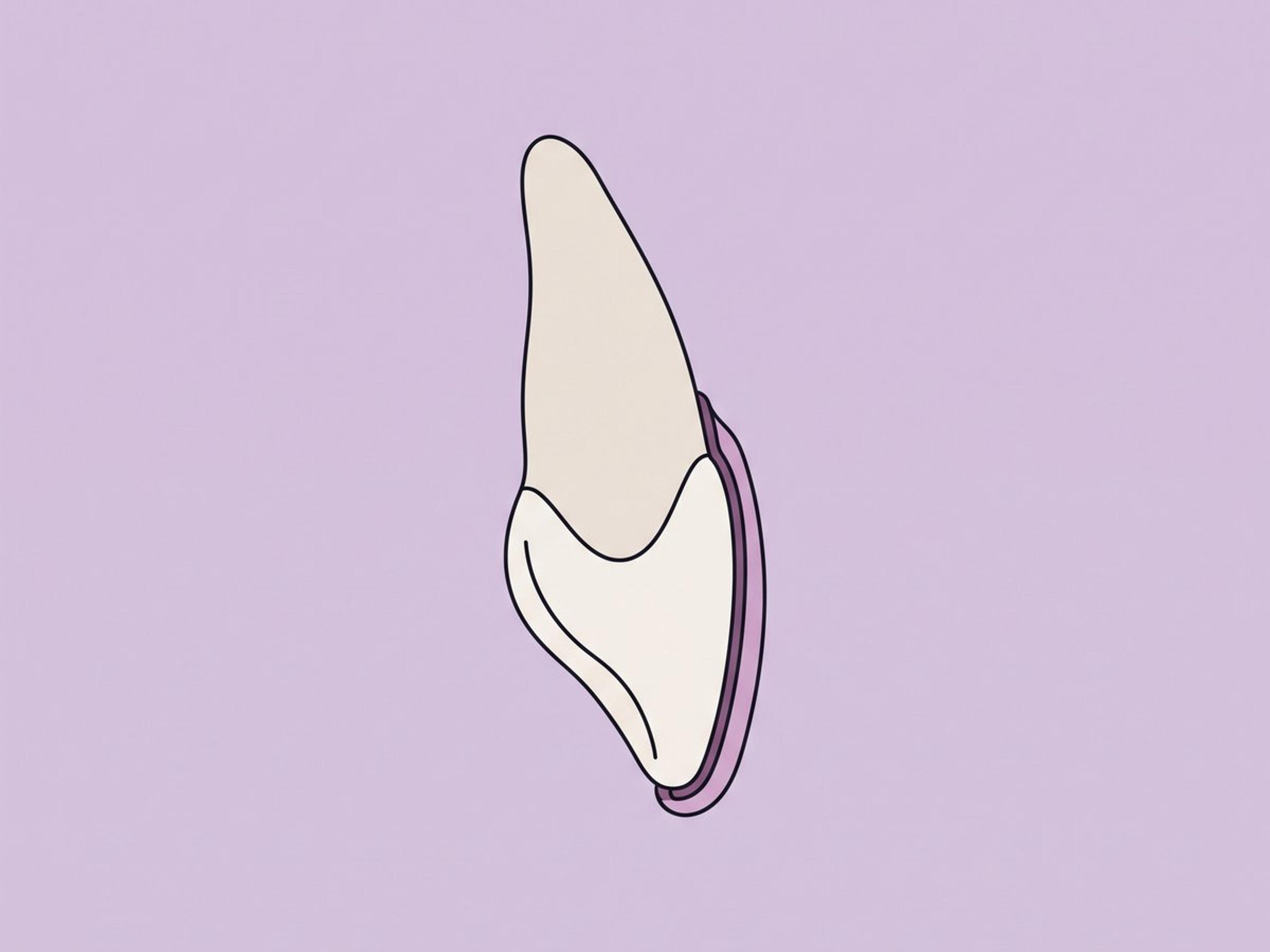
Tooth-coloured composite bonded and sculpted onto the tooth in a single visit and cured with a light. It removes less enamel, is repairable in the chair and costs less, but it stains and wears faster than ceramic. Retrospective clinical data report annual failure rates near 5% on vital teeth and roughly double that on non-vital teeth.
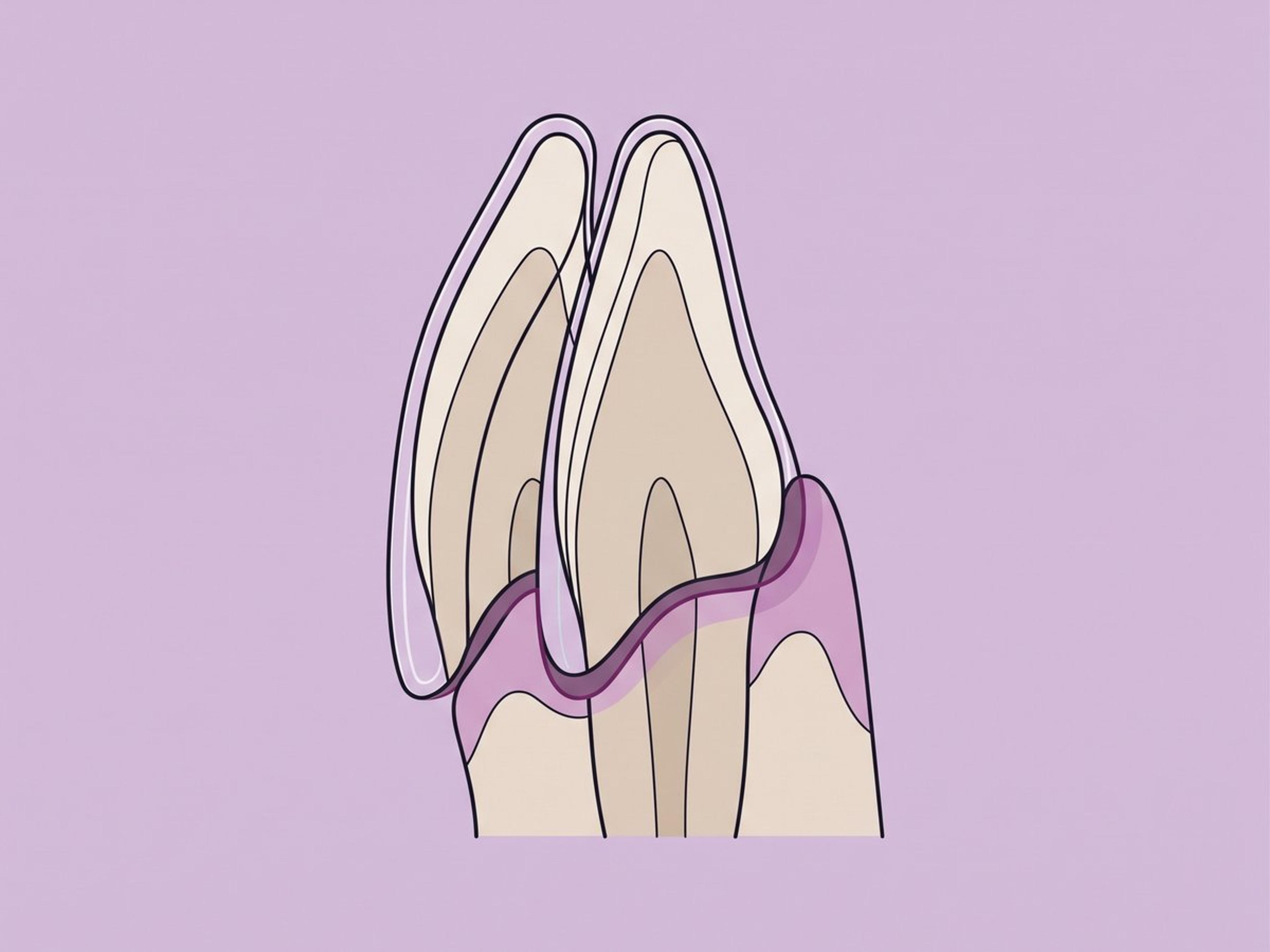
Ultra-thin ceramic bonded with little or no enamel reduction, suited to teeth that are small, worn or retroclined. Most designs sold as no-prep still involve some enamel contouring, so the treatment remains effectively irreversible. Adding thickness without reduction leaves bulky emergence profiles that irritate the gum margin, and it is the wrong choice for teeth that already sit forward or are crowded.
A course of veneers, visit by visit
Wax-up and mock-up, before any enamel comes off
The diagnostic wax-up is transferred into your mouth in temporary material so length, shape and proportion are agreed while your teeth are still intact — and so you can speak with it, which is where most designs that look right in photographs fall down. It then becomes the reference for reduction: enamel is measured away from the planned surface rather than from the tooth you have now, which is what stops a case being over-prepared to disguise crowding.
Preparation under local anaesthetic
Depth-cutting burs mark a fixed reduction — a few tenths of a millimetre — through the mock-up, and the enamel is taken down to those marks rather than by eye. Staying inside enamel is the single biggest lever on how long the veneers last: pooled survival is around 99% where the preparation stays in enamel and about 91% where dentin is substantially exposed.
Scan, shade and temporaries
The prepared teeth are scanned and the shade recorded against the teeth that are staying, before dehydration from a long appointment lightens everything and distorts the match. Temporaries are made from the same wax-up: they cover exposed dentin, hold the teeth and gum margins in position while the laboratory works, and let you live with the shape for the 3 to 5 days it takes.
Bisque try-in
The veneers come back unglazed and are tried on with water or try-in paste so contour, midline, length and shade can be corrected while correction still means an afternoon at the laboratory. This is the appointment compressed packages quietly drop; after glazing and bonding, a change means remaking the veneer.
Adhesive bonding
The teeth are isolated — rubber dam where the case allows — then etched and primed, the fitting surface of the ceramic is etched and silanated, and resin cement is light-cured through the veneer. A veneer has almost no mechanical grip, so the bond is the retention: saliva or blood reaching a prepared surface at this step is what shows up as a debond months later.
Cement removal and bite adjustment
Excess cement is cleared from the gum crevice and the margins polished, because cement left behind causes chronic inflammation and bleeding that is easily mistaken for a badly fitting veneer. The occlusion is then marked and adjusted so no single veneer takes the first contact, and checked again at a separate appointment once the anaesthetic has fully gone and you have eaten properly — a bite can feel level while you are numb and high the next morning.
Dental veneers: recovery week by week
- Preparation day
Numbness fades over 2 to 4 hours; wait for it before eating so you do not bite a lip or cheek you cannot feel. There is no wound and nothing to restrict — work, the gym and swimming are all fine the same day. Prepared teeth are sensitive to cold and to air until the definitive veneers are on, and gum handled during preparation stays tender for a few days.
- Days 2–5, in temporaries
Laboratory time. Temporaries are provisional by design and are bonded weakly on purpose so they come off cleanly later: nothing hard or sticky, do not tear food with the front teeth, and pull floss out sideways rather than up. If one loosens it goes back on the same day — an uncovered prepared tooth is sharply sensitive, and neighbouring teeth begin drifting within days, which changes the fit of a veneer already being made.
- Bonding day
Try-in and bonding, and the first time you see the finished result — the shade set at cementation is the shade you keep, since neither ceramic nor composite responds to bleaching, so this is the appointment to raise anything you dislike. You eat and speak normally the same evening, but the resin cement gains strength over roughly 24 hours, so leave hard and chewy food until the next day.
- Week 1
Cold sensitivity eases and the gum margins settle, with light bleeding on brushing fading within days provided the margins are kept clean. The bite should feel even: if one tooth meets first, say so rather than waiting, because a high contact does not settle by itself and concentrates load on ceramic that fractures under it. Pain that lingers after the cold is gone, wakes you at night or starts unprovoked is an inflamed nerve, not settling sensitivity.
- Weeks 2–12
Speech adapts to the new edge position within a week or two, and the veneers stop feeling like objects in the mouth. Sensitivity should be clearly gone by around 3 months; persistence past that warrants investigation rather than waiting it out, since it usually points to an exposed dentin margin or a pulp that has not recovered. If you grind, this is when the night guard becomes a permanent habit, not an optional one.
- 6–12 months and beyond
Fracture and debonding cluster in the first 2 years after cementation, so the 6- and 12-month reviews are the ones that matter most — agree in writing before you fly home who carries them out and who pays if a veneer fails. After that it is ordinary maintenance: six-monthly examinations and hygiene visits, because decay at a veneer margin is silent and progresses under the restoration where only radiographs and a probe will find it.
Dental veneers: how to prepare
- Full dental examination with radiographs. Untreated decay, failing restorations and periodontal disease are treated and stable before a single tooth is prepared, not covered over.
- Any whitening of the natural teeth is completed first and the shade left to settle. The veneer shade is matched to that final result and ceramic cannot be lightened afterwards.
- Occlusal assessment for clenching, grinding, deep overbite and anterior guidance. Where the bite is the problem, it is managed before treatment or treatment does not go ahead.
- A diagnostic wax-up and an intraoral mock-up you can look at and speak with, so shape, length and proportion are agreed while your enamel is still intact.
- Depth-controlled reduction planned against that mock-up, to keep the margins in enamel wherever the case allows — enamel-bonded veneers outperform dentin-bonded ones in every systematic review of the material.
- Confirm that the person preparing your teeth is a registered dentist. The American Dental Association has warned that irreversible work carried out by unlicensed 'veneer technicians' risks damage to tooth structure, nerve injury and infection.
Dental veneers: risks
Every operation carries risk. We name them so you can ask the right questions.
- Enamel removal is permanent. The tooth cannot return to its unrestored state and will need a veneer, crown or other covering for the rest of its life.
- Fracture or chipping of the ceramic — the commonest failure mode. Around 96% of porcelain laminate veneers remain fracture-free at 10 years, which also means some do not.
- Debonding of the veneer from the tooth, more likely where the preparation has run into dentin rather than staying within enamel.
- Thermal sensitivity from dentin exposed during preparation. Usually transient, occasionally persistent — and persistence past 3 months needs investigating, not waiting out.
- Marginal staining, marginal breakdown and secondary decay at the veneer-tooth junction, which can progress unseen beneath the restoration.
- Shade mismatch, or simply not liking the colour. Ceramic and composite do not respond to bleaching agents, so a shade you dislike is replaced, not whitened.
- Fracture and debonding cluster in the first 2 years after cementation — which, for a patient treated abroad, is usually after the flight home.
- Veneers placed over untreated decay or active gum disease can worsen the underlying disease while making it harder to detect.

Dental veneers in Turkey: what to expect
A course of veneers is a schedule, not an operation. Whether it works in one trip comes down to two things — how healthy your teeth already are, and how fast the laboratory turns the case around.
Before you fly
Send radiographs and photographs before you book anything. If preparatory work is needed, it has to be finished and stable before a tooth is prepared, and the honest answer then is two trips. Ask us the questions the General Dental Council tells patients to ask when travelling for treatment: who is carrying out the work and what are they qualified in, how many times have they done it, what aftercare is included and who do you contact, is further treatment covered if there is a complication, who pays for extra flights and hotel nights if you are unhappy, and can you see our complaints procedure. We would rather answer all of that in writing before you spend money on a flight.
At the clinic
The irreducible minimum is 2 appointments — preparation with a scan, then bonding. A course that also includes a bisque try-in, which is the appointment where shade, contour and occlusion are actually corrected before the ceramic is glazed, needs 3 or 4. Ask where the laboratory sits and what its turnaround is, because a one-trip course only holds together if the case comes back in 3 to 5 days. Ask as well whether the plan is veneers or crowns and how much tooth structure comes off — a tooth reduced all the way round for a crown is a different and more destructive procedure, and package pricing frequently blurs the two. Turkey's Ministry of Health requires an International Health Tourism Authorisation Certificate of any facility treating international patients, and your dentist should be registered with a provincial Dental Chamber of the Turkish Dental Association, which organises registration through 34 chambers. Ask for both by name.
Recovery in Istanbul
Plan 8 days in Istanbul and 7 hotel nights, with 3 appointments inside that window. There is no downtime — the local anaesthetic wears off within a few hours, and you eat and speak normally the same day the veneers are bonded. Between preparation and bonding you wear temporaries: nothing hard or sticky, no biting with the front teeth, and if one comes loose it goes back on the same day so the teeth do not drift. Prepared teeth are often sensitive to cold and to air until the definitive veneers are in, and the gum traumatised during preparation settles over the same week.
Heading home
Bonding falls near the end of the stay, so a day-8 flight sits at the 24-hour minimum rather than the preferred 7 days after restorative treatment. If your schedule allows the extra days, take them. Leave with the written treatment plan, the specific ceramic used, the shade, and pre- and post-operative radiographs — a dentist at home cannot sensibly rebond or repair a veneer without knowing what it is made of. Agree with us in writing who reviews the work at 6 and 12 months and what happens if a veneer debonds after you are home. That is the part most people skip: in the British Dental Association's 2022 survey of 1,000 UK dentists, 94% had examined patients who travelled abroad for treatment and 86% had treated cases that developed problems, with two-thirds saying remedial work cost the patient at least £500.
- United Kingdom
- £500 – £1,000 per tooth
- United States
- $1,000 – $2,500 per tooth
- Western Europe
- €700 – €1,500 per tooth
Published typical ranges for orientation — confirm with a local quote.
Dental veneers: frequently asked questions
How long do dental veneers actually last?
Systematic review evidence puts 10-year cumulative survival of porcelain laminate veneers at about 95.5% across 6,500 veneers in 1,646 patients, and a 2025 meta-analysis reports pooled survival of 96.1% for feldspathic and 96.8% for lithium disilicate at a mean 10.4 years. Direct composite performs less well, with annual failure rates near 5% on vital teeth. Conclusive data beyond 20 years does not exist, so a lifetime veneer is not something anyone can honestly offer you.
Do veneers ruin your teeth, and can they be taken off?
For most veneer types enamel is removed from the front and sides of the tooth, and enamel does not regenerate. The treatment is therefore not reversible — once a tooth is prepared it will need a veneer, crown or other restoration permanently. Removing a veneer without replacing it leaves a prepared, sensitive, unprotected tooth.
Porcelain or composite — which should I choose?
Porcelain is stronger, more stain-resistant and holds its appearance longer, but it costs more and needs laboratory fabrication across 2 or more visits. Composite removes less enamel, can often be done in one visit and is repairable in the chair, but it stains and wears faster. Where the defect is minor, composite is the more conservative place to start.
What do veneers cost in Istanbul?
We work at €250 to €500 per tooth, all in, for laboratory-made ceramic veneers — roughly €2,000 to €4,000 for 8 upper anterior teeth and roughly €5,000 to €9,000 for a full 20-unit upper and lower course. That covers the treatment week, transfers and hotel, but not international flights and not any preparatory dentistry, which we quote separately. For comparison, the last US national average the American Dental Association ever published was $1,050 for a single porcelain laminate veneer — a dentist's fee alone, from 2013, with no newer official figure since the survey was discontinued in 2023.
Can a full course of veneers really be done in one trip?
For a straightforward aesthetic case on sound, periodontally stable teeth, yes — with 8 days in Istanbul and a laboratory that returns the case in 3 to 5 days. The moment preparatory work is needed — periodontal treatment, decay, root canal treatment, orthodontic alignment — it has to be completed and stable before teeth are prepared, and that does not compress into the same week. Anyone quoting a single-week course without having seen your radiographs is quoting a package, not planning treatment.
How soon after bonding can I fly?
The minimum interval after restorative treatment is 24 hours, with one week the general recommendation after most dental work — cabin pressure provokes pain in recently restored teeth, and the British Dental Journal attributes close to a third of in-flight dental pain to recent restorative treatment. The stronger argument for staying is practical: a high bite, a debond or a shade you dislike takes minutes to correct here and is expensive to correct from another country. If preparatory surgery was involved the intervals lengthen sharply — 72 hours after a surgical extraction or implant, and 6 weeks after a sinus lift.
Are no-prep veneers really no-prep?
Most veneers marketed as no-prep or minimal-prep still involve some enamel contouring, so the treatment stays effectively irreversible. They also add thickness to the front of the tooth, which suits small, worn or retroclined teeth but looks and feels bulky on teeth that already sit forward. Whether a genuinely additive approach is possible depends on where your teeth start, not on the product name.
Can I whiten veneers later if they darken?
No. Ceramic and composite do not respond to bleaching agents, so the shade set at cementation is the shade you keep, and whitening afterwards will only lighten the natural teeth around them. Surface staining on composite can sometimes be polished off; ceramic that no longer matches has to be replaced.
Can I have veneers if I grind my teeth?
Grinding, clenching and a deep overbite that heavily loads the upper front teeth all raise fracture and debonding risk, and the American Dental Association lists them among the circumstances where veneers may not be a good choice. Some patients can be treated after occlusal management and with a night guard worn indefinitely, but that decision is made before a tooth is prepared, not after a veneer fractures. On a compressed travel schedule this matters more, because both failure modes cluster in the first 2 years.
Who is not a good candidate for veneers?
Anyone whose enamel is largely gone — from acid erosion, heavy wear or previous preparation — because the adhesive bond that carries a veneer holds to enamel, and survival falls sharply once the margins sit in dentin. Teeth with large existing fillings or root canal treatment usually need crowns rather than veneers, and severe crowding or rotation is an orthodontic problem that ceramic can only disguise at the cost of aggressive tooth reduction. Active decay and gum disease rule treatment out until they are resolved, and unmanaged grinding or a deep, heavily loaded bite raises the failure rate enough that the occlusion is dealt with first or we advise against treatment. None of this can be judged from a photograph, which is why we ask for radiographs before you book anything.
When should I contact the clinic after my veneers are bonded?
Contact us if the bite feels high — one tooth meeting before the others — because a high contact does not settle on its own and overloads the ceramic until it is adjusted. Cold sensitivity should ease over days to weeks; pain that lingers after the stimulus is gone, wakes you at night or arrives spontaneously suggests an inflamed nerve and needs assessment, not patience. A veneer or temporary that comes loose should be kept, never glued back with household adhesive — the tooth underneath is prepared and unprotected, so tell us the same day. Gum bleeding or swelling at the veneer margins that persists beyond the first week, or any chip or crack in the ceramic, is also worth a message with a photograph straight away — most of these are minutes to fix if we hear about them early.
Are veneers maintenance-free once they are on?
No. The tooth behind the veneer is still a living tooth: it can decay at the margins, and the gum around it can still recede and expose the junction. The maintenance is unglamorous — brushing, interdental cleaning, hygienist visits and regular check-ups so marginal problems are caught while they are small, plus a night guard worn indefinitely if you grind. Composite additionally picks up stain from coffee, red wine and smoking and needs periodic repolishing. And nothing bonded to a tooth is permanent: even well-kept ceramic is eventually repaired or replaced, so the realistic plan is 10 to 15 well-maintained years and a replacement cycle after that, not a set-and-forget smile.
How much does dental veneers cost in Turkey?
€250 to €500 with us, confirmed after a consultation rather than quoted blind. For comparison it is typically £500 – £1,000 per tooth in the United Kingdom, $1,000 – $2,500 per tooth in the United States and €700 – €1,500 per tooth in Western Europe. Per tooth, and the material decides most of it: composite at the bottom, e-max and zirconia above. The other variable is how many teeth are treated, since a symmetrical result usually means more than you first assume.
Sources
- [1]Long-Term Survival and Complication Rates of Porcelain Laminate Veneers in Clinical Studies: A Systematic Review · Journal of Clinical Medicine (PubMed Central) · 2021
- [2]Dental Fees: Results from the 2013 Survey of Dental Fees (General Practitioners, National, CDT D2962) · American Dental Association Health Policy Institute · 2013
- [3]Survival and Complication Rates of Feldspathic, Leucite-Reinforced, Lithium Disilicate and Zirconia Ceramic Laminate Veneers: A Systematic Review and Meta-Analysis · Journal of Esthetic and Restorative Dentistry (PubMed) · 2025
- [4]Clinical survival and complication rate of ceramic veneers bonded to different substrates: A systematic review and meta-analysis · The Journal of Prosthetic Dentistry (PubMed) · 2024