
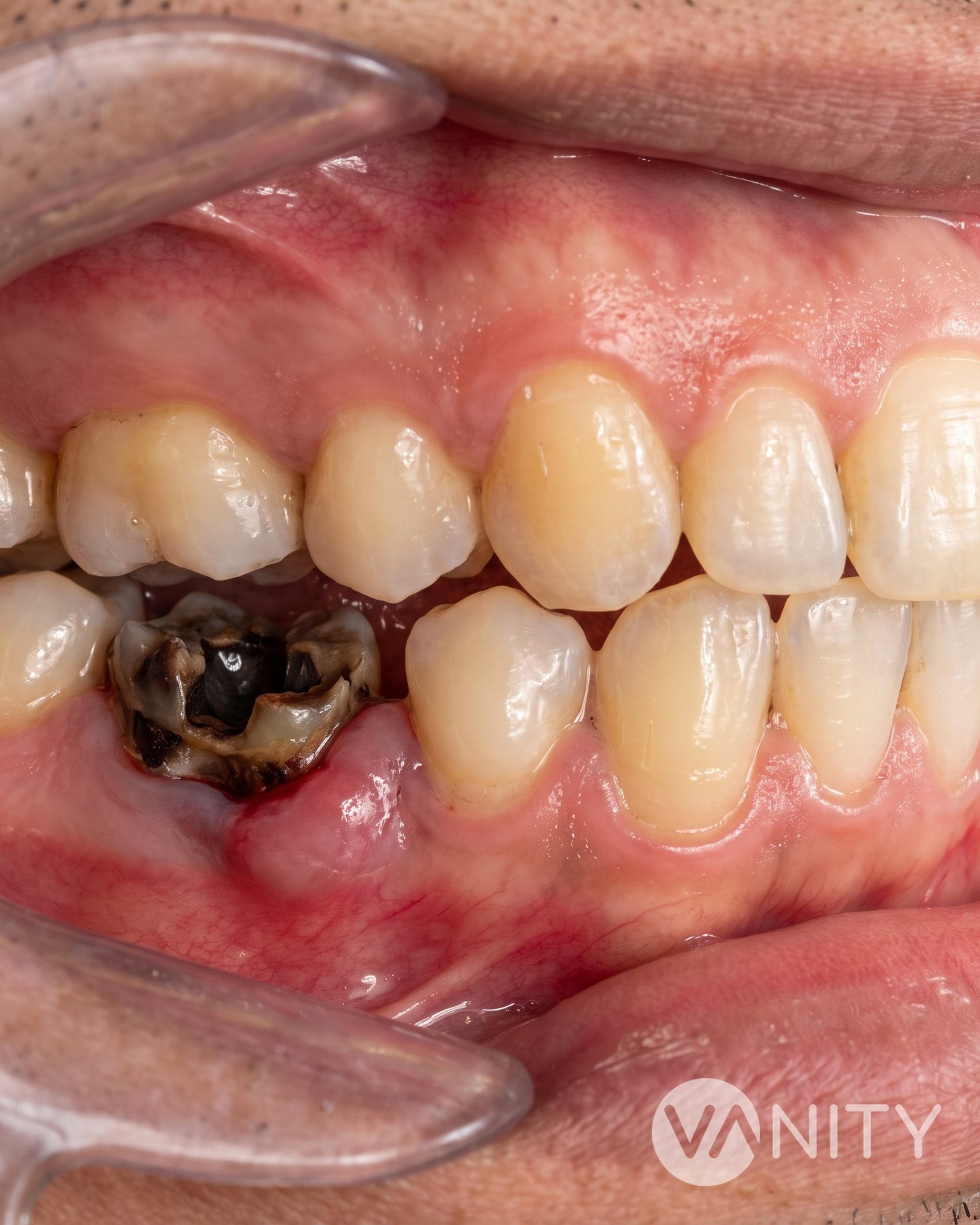
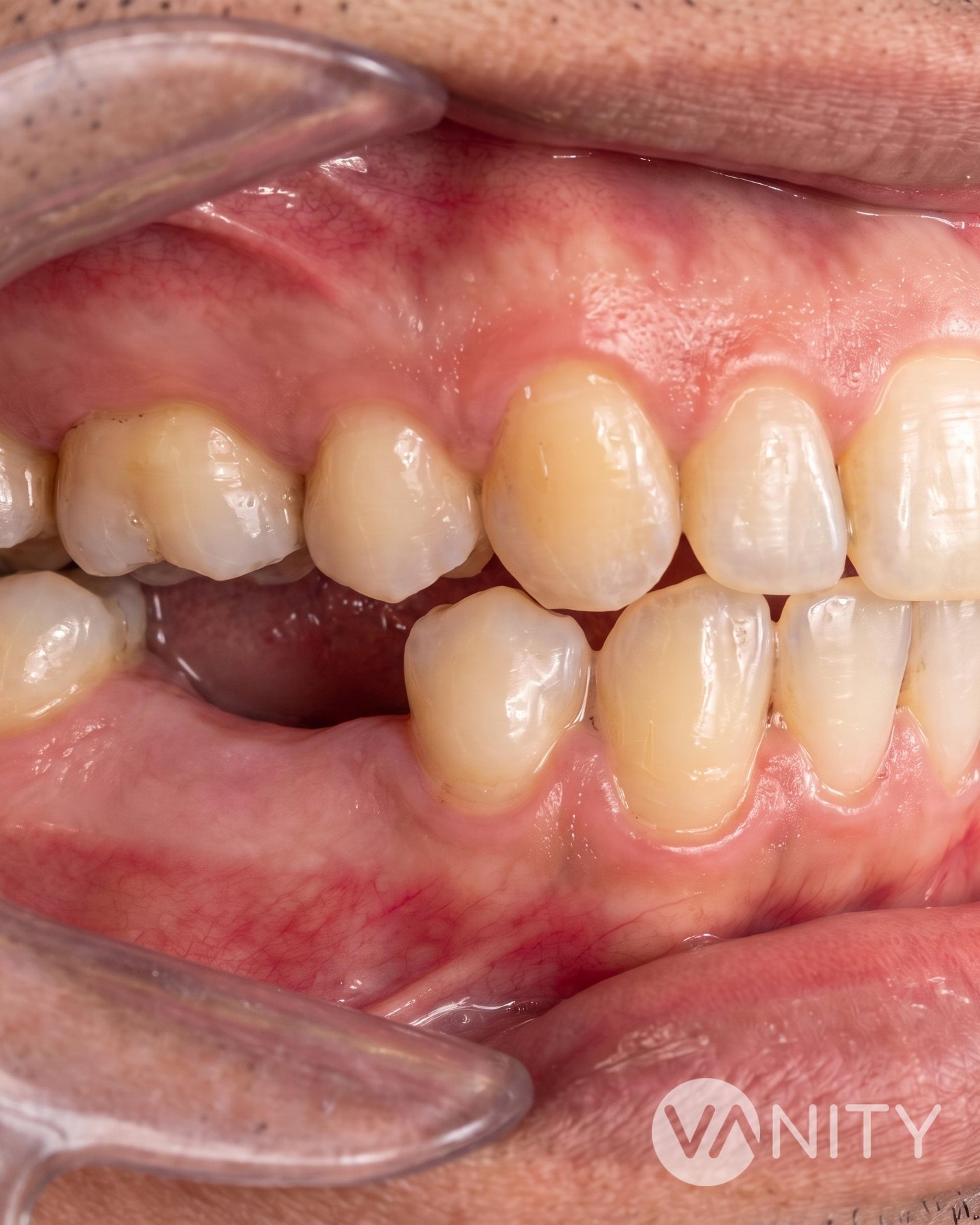

What it is
An extraction takes the whole tooth, root included, out of the jawbone. You are numbed with local anaesthetic, the tooth is loosened from the ligament holding it with an elevator and lifted out with forceps. Where the tooth is buried or the access is poor, we open the gum, take away a small amount of bone, or divide the tooth and remove it in pieces. The socket is cleaned and often stitched, and the blood clot that forms in it is the scaffold everything else heals on — which is why the first 48 hours matter more than they seem to.
It is the right treatment for a tooth broken or decayed beyond repair, a tooth whose supporting bone has already gone to gum disease, an impacted or half-erupted wisdom tooth causing infection, decay or a cyst, a baby tooth that never left, and teeth removed on orthodontic advice to make room. If you take anticoagulants, bisphosphonates or denosumab, immunosuppressants, or have had high-dose radiotherapy to the head or neck, that does not rule you out — it changes the plan, and in the case of antiresorptive drugs it changes whether the tooth should come out at all. Tell us at the enquiry stage, not on the day.
Techniques we use
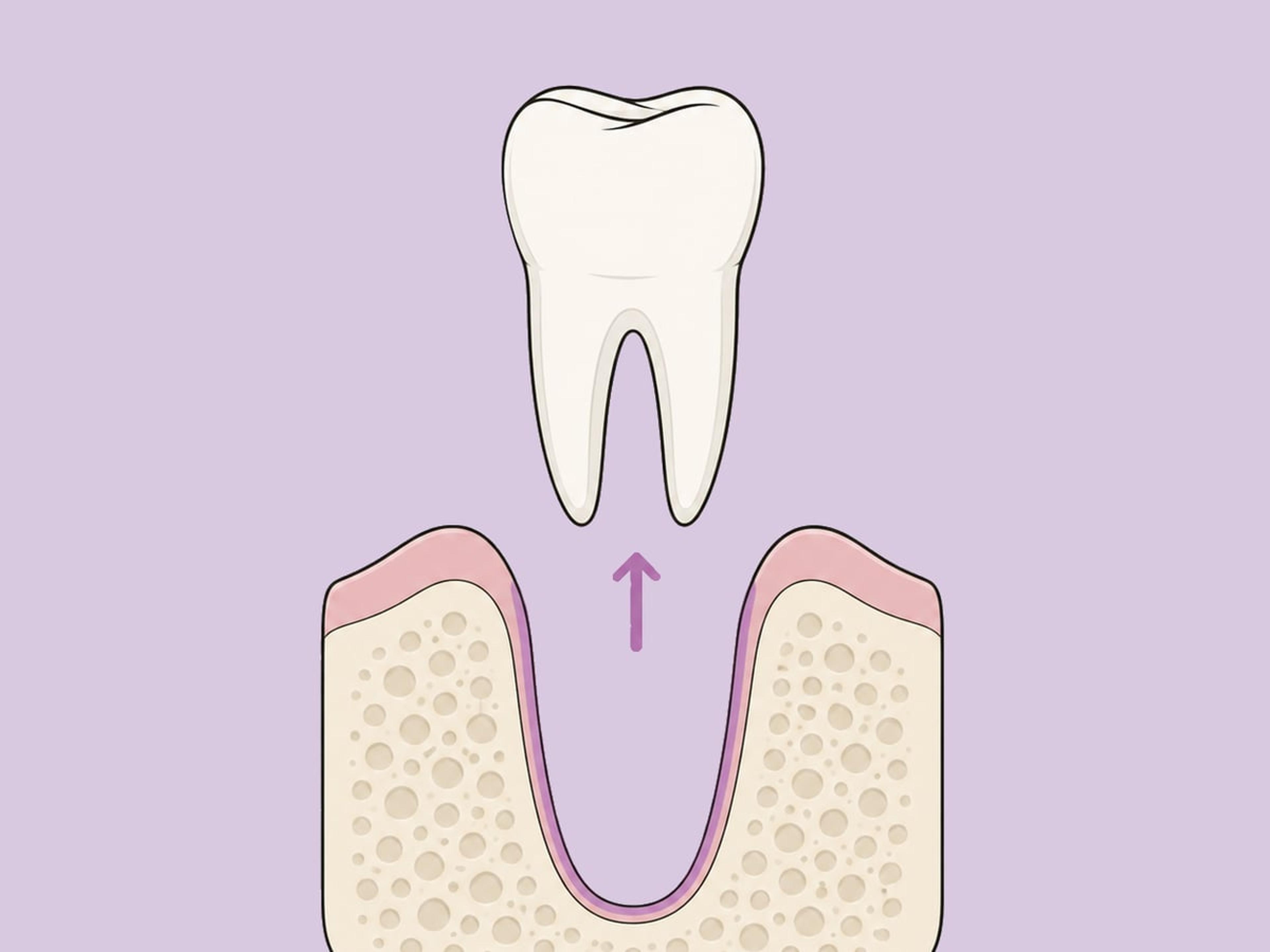
For a tooth that is fully through the gum and reachable with forceps. After anaesthetic the tooth is rocked with an elevator to widen the socket and tear the periodontal ligament, then lifted out — no flap raised, no bone removed. This is the default and the shortest of the four.
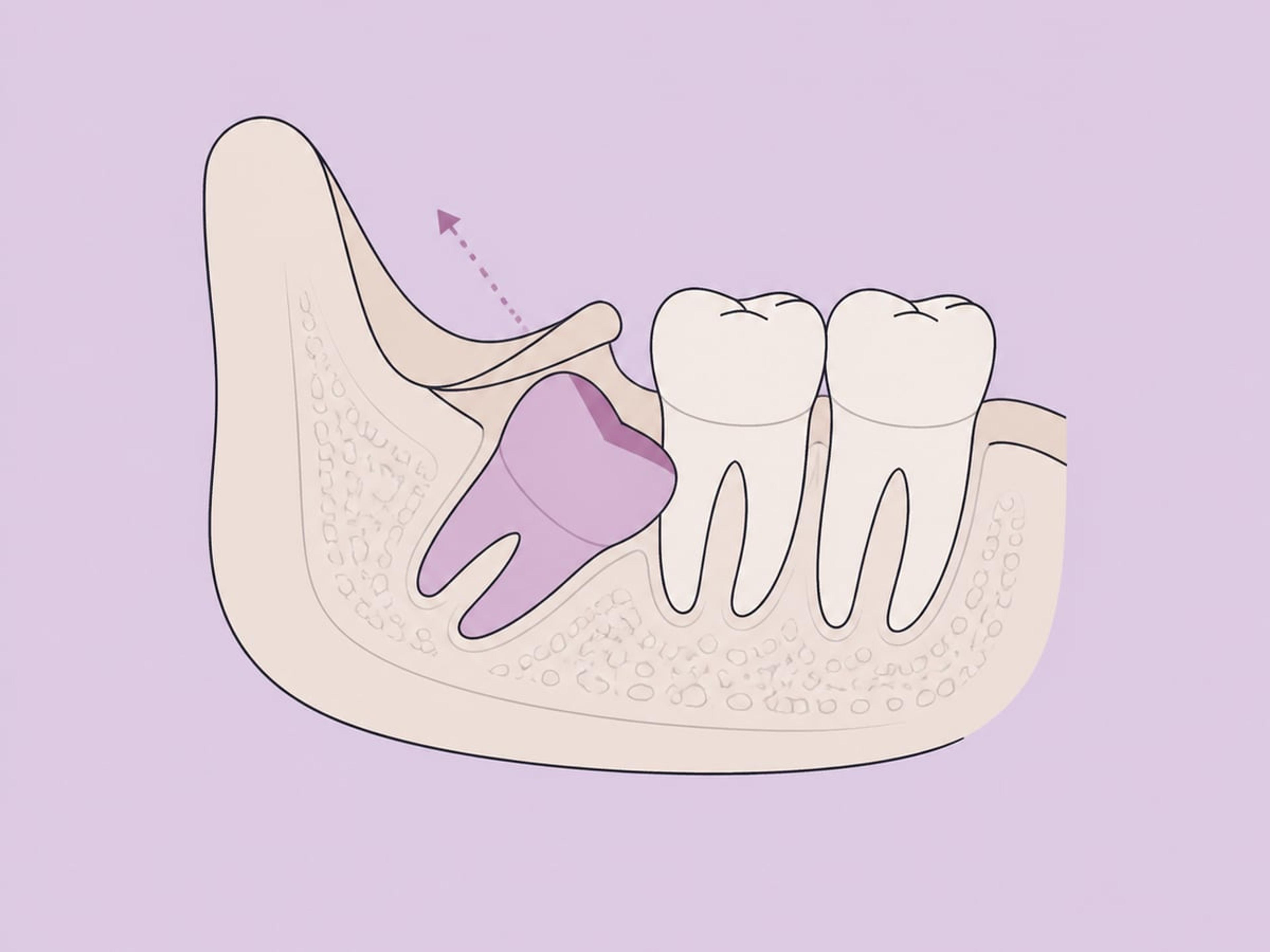
Needed for impacted, buried, root-filled or fractured teeth, and for most lower wisdom teeth. A gum flap is raised, the bone covering the tooth is trimmed with a bur, and the crown and roots are usually sectioned so each fragment comes out through a smaller opening. The flap is laid back and closed with resorbable sutures.
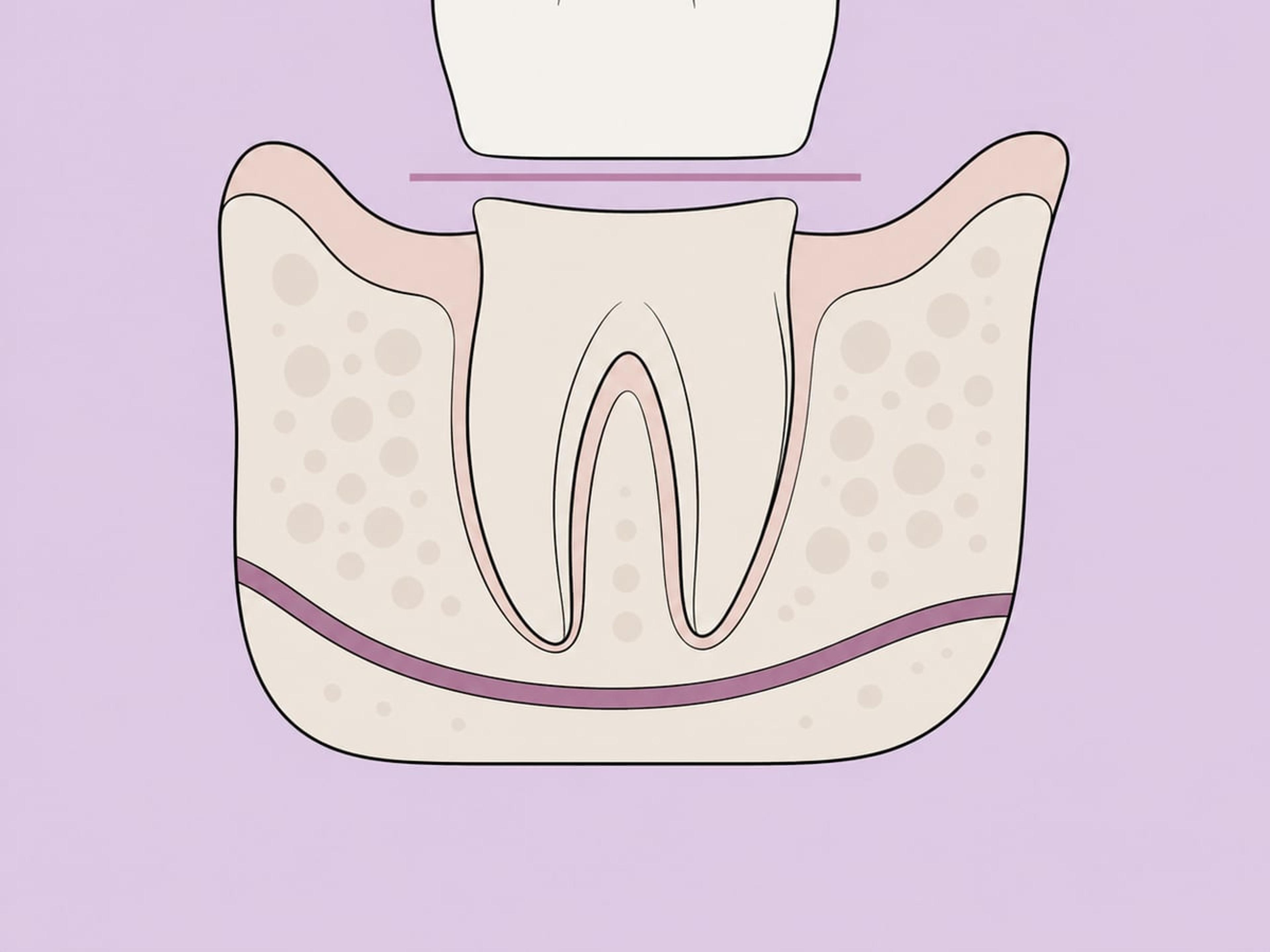
An option for lower wisdom teeth whose roots sit against the inferior alveolar canal on the radiograph. The crown is removed and the roots are deliberately left where they are, below the bone crest, so the nerve is never touched. It trades a small chance of the roots migrating later and needing a second operation against the risk of permanent numbness of the lip and chin — a trade we will put to you in those terms.
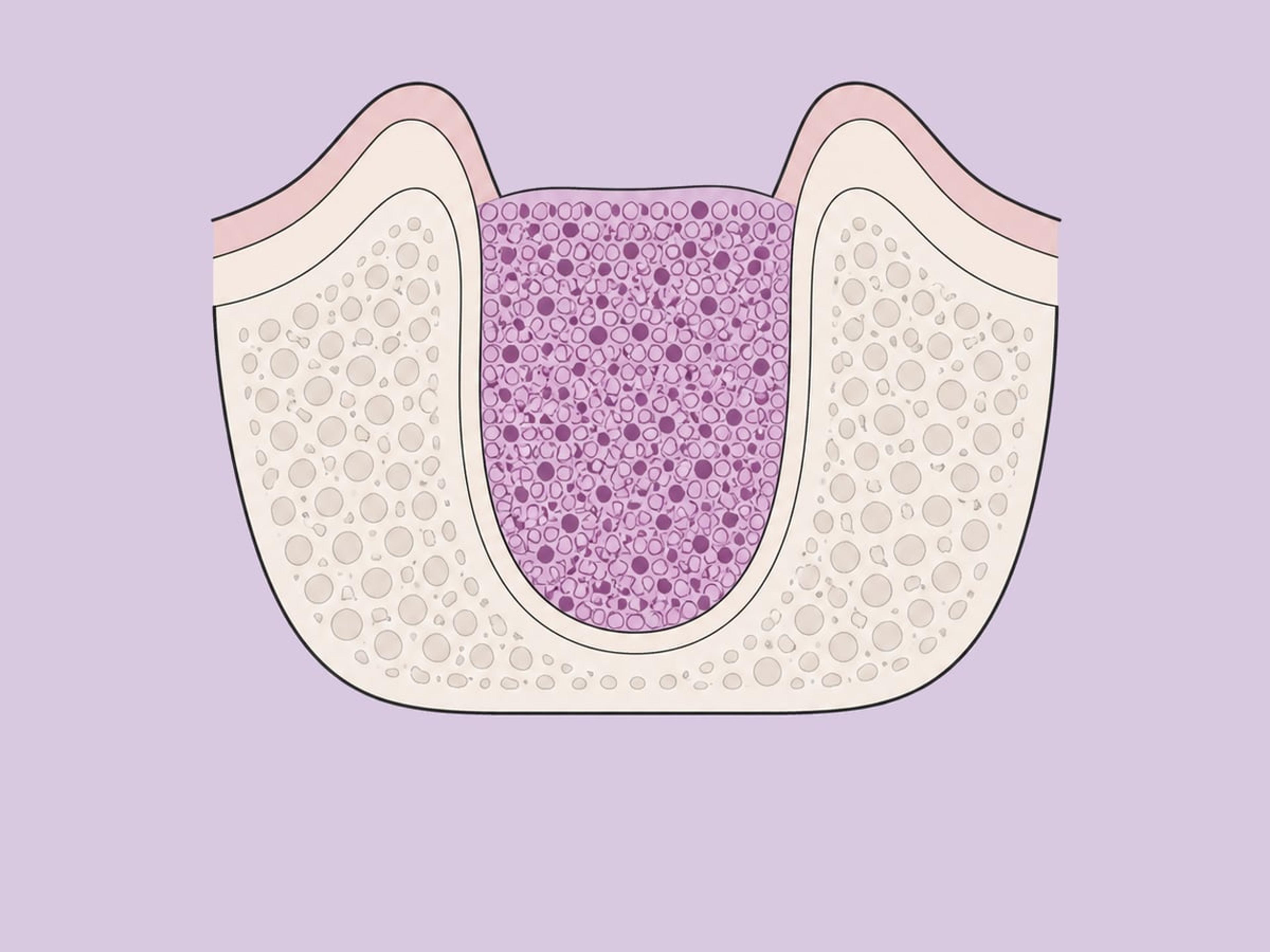
Bone graft material, with or without a membrane, is placed into the fresh socket at the time of extraction to slow the ridge collapse that follows losing a tooth. Left to heal on its own, a ridge loses a mean of about 3.8 mm horizontally and 29-63% of its width by 6 months, around two-thirds of that in the first 3. We use it mainly where an implant or a fixed bridge is already planned, so the decision belongs at the consultation, not afterwards.
The extraction, step by step
The film is read before anything is numbed
A periapical or panoramic radiograph — a CBCT where a lower wisdom root looks intimate with the nerve canal — decides whether this is a closed extraction, an open one, or a coronectomy. The approach is chosen from the image rather than discovered halfway through, which is the difference between a planned operation and an improvised one.
Anaesthesia
Upper teeth are numbed by infiltration next to the socket; lower molars need an inferior alveolar block, which numbs the lip and tongue on that side as well. Sedation is available if you are anxious, and it changes the day rather than the operation — you will need an escort and the fasting instructions we give you.
The tooth is loosened, not pulled
A tooth is held by the periodontal ligament, not cemented in, so most of the work is an elevator patiently widening the socket and tearing that ligament. This is why you feel firm pressure and movement while feeling no pain, and why an unhurried extraction takes less bone with it.
Delivery — whole, or in sections
Where the tooth is reachable it is lifted out intact with forceps. Where it is impacted, buried or root-filled and brittle, a gum flap is raised, a small amount of overlying bone is trimmed and the tooth is divided so each fragment leaves through a smaller opening — sectioning removes far less bone than forcing a whole tooth through a narrow socket.
The socket is cleaned and closed
Any follicle or granulation tissue is removed, the socket is irrigated, and if socket preservation was agreed at the consultation the graft goes in now — it cannot be added later. A flap is closed with resorbable sutures; the clot that forms in the socket is the scaffold every subsequent stage of healing is built on.
Before you leave the chair
You bite firmly on damp gauze for around 30 minutes, which is what actually stops the bleeding — checking it every few minutes does not. You leave with written aftercare, pain relief that is not aspirin, and the review appointment already booked, because the complications that matter declare after you have left the building.
Recovery, week by week
- First 24 hours
Bleeding stops with gauze pressure and a clot forms. Protect it: no rinsing, spitting, straws, smoking or vaping, and nothing hot while you are still numb. Almost everything that goes wrong in the next week is decided here.
- Days 2–3
Pain and swelling peak, then start to turn. Paracetamol and ibuprofen cover it; cold packs help the cheek. Gentle warm saltwater rinsing can begin at 24 hours, and most people are back to routine activity — desk work, walking, driving — by 48 to 72 hours.
- Days 3–5
The dry-socket window, and the reason we keep you in Istanbul to day 5. Pain that eased and then returned as a severe ache radiating to the ear is the clot failing, and it is treated with a dressing in a chair — often more than once. Your review visit falls here, and you fly home after it.
- Weeks 1–2
The gum surface closes over and any resorbable sutures fall away. Hard exercise, heavy lifting and contact sport wait until about a week — raised blood pressure can restart bleeding from a socket that has only just settled. Jaw stiffness after a lower wisdom tooth can run the full fortnight.
- 1–4 months
The socket fills with bone from the base upward — most of it in the first three months, up to about four for a large molar. This is the wait that sets implant timing: the European Workshop in Periodontology consensus places implants into a substantially filled socket at conventionally 12 to 16 weeks, which is your second trip if one is planned.
How to prepare
- Give us the full medical and drug history in writing — anticoagulants and antiplatelets, bisphosphonates or denosumab, immunosuppressants, how well controlled your diabetes is, and any head-and-neck radiotherapy. Antiresorptive drugs are generally not stopped; there is not enough evidence that a drug holiday prevents osteonecrosis of the jaw.
- Expect imaging before anything is agreed: a periapical or panoramic radiograph as standard, and a CBCT scan where a wisdom tooth root looks intimate with the nerve canal, so that coronectomy can be considered rather than discovered.
- Decide the replacement plan before the tooth comes out — implant, bridge, denture or nothing — because that decides whether socket preservation grafting happens at the same visit or not at all.
- Agree the anaesthetic plan. If you choose sedation or general anaesthesia, arrange someone to accompany you and follow the fasting instructions you are given.
- Stop or cut down smoking before and after. Smokers have over three times the risk of dry socket, and it is the single modifiable factor that matters most here.
- Have soft food, cold packs and paracetamol or ibuprofen waiting at the hotel for the first 48 hours. Not aspirin — it worsens bleeding.
Risks
Every operation carries risk. We name them so you can ask the right questions.
- Dry socket (alveolar osteitis) — the clot is lost or fails, leaving bone and nerve endings exposed and causing severe radiating pain. It follows roughly 2-5% of extractions, more often after wisdom teeth, and smokers carry over three times the risk. It almost always declares within the first 3 to 5 days.
- Infection of the socket — swelling, pus, a bad taste and fever, typically appearing 4 to 6 days after the extraction and sometimes needing antibiotic treatment.
- Nerve injury — damage to the inferior alveolar or lingual nerve after lower wisdom tooth removal, causing numbness or tingling of the lip, chin or tongue. Usually temporary. Occasionally permanent.
- Prolonged or secondary bleeding, more likely if you are taking anticoagulant or antiplatelet drugs.
- Oro-antral communication, or a root pushed into the maxillary sinus, when upper molars and premolars are removed.
- Medication-related osteonecrosis of the jaw in patients on antiresorptive or antiangiogenic drugs — rare with oral bisphosphonates taken for osteoporosis, but reported in roughly 1-10% of patients on intravenous bisphosphonates for cancer.
- Damage to what is next to the tooth — fracture of the tooth or its root during removal, injury to neighbouring teeth or fillings and crowns, and the progressive ridge resorption that continues after healing.

What to expect in Turkey
An extraction is a day case — you arrive, you are numbed, the tooth comes out and you leave the same day. What shapes the trip is not the appointment but the two complications that declare late, and whether you are still within reach of the person who treated you when they do.
Before you fly
Ask for the name of the person who will hold the forceps, in writing, before any deposit is paid. Surgical extraction is a different competence from routine restorative dentistry, and the registrations worth checking sit in a specific order: the facility's International Health Tourism Authorisation Certificate from the Turkish Ministry of Health, mandatory since the 2017 regulation and issued per branch rather than per group; then the named dentist's or maxillofacial surgeon's registration with the provincial dental chamber under the Turkish Dental Association. If an immediate denture or a partial is going in on the day, we need impressions or an intraoral scan 2 to 3 days ahead, which means arriving earlier — not staying longer.
At the clinic
We take the radiograph, review the drug history against what you sent us, and confirm the approach — closed, open, or coronectomy — before anything is numbed. A single tooth is 30 to 60 minutes in the chair. If the plan changes on the radiograph, for instance a root sitting closer to the nerve canal than expected, we stop and talk about it with you rather than proceeding and explaining afterwards.
Recovery in Istanbul
Plan on 5 days in Istanbul and 4 hotel nights, with 1 review visit. Pain is worst on days 2 and 3, swelling settles over 5 to 7 days, and normal activity usually resumes 48 to 72 hours after the extraction. The reason for the fifth day is dry socket: it presents 3 to 5 days after treatment and post-operative infection 4 to 6, and dry socket treatment is a simple dressing — but it needs a chair, and it often needs it more than once.
Heading home
Flying at 48 hours is defensible after a simple extraction. We would rather you flew on day 5, because by then the dry-socket window has largely passed while you are still a short taxi ride from the person who treated you, instead of presenting to a stranger at home. Leave with the operative note, the radiographs and the surgeon's name, and arrange whoever will review you at home before you fly out rather than after — continuity of care is the genuine weak point of treatment abroad, and a home dentist asked to manage bleeding or infection without records is being set up to fail.
- United Kingdom
- £100 – £400 per tooth
- United States
- $150 – $600 per tooth
- Western Europe
- €80 – €400 per tooth
Published typical ranges for orientation — confirm with a local quote.
Frequently asked
Does having a tooth pulled hurt?
The extraction itself should not hurt — the tooth and the tissue around it are numbed first, so you feel pressure and movement but not pain. Sedation is available if you are anxious. Afterwards, discomfort is normal and usually peaks around the third day; paracetamol and ibuprofen handle it, and aspirin is avoided because it worsens bleeding.
Is there anyone who shouldn't have a tooth extracted?
Almost no one is ruled out outright, but several things change the plan and one can change the decision. Anticoagulants and antiplatelets are generally continued, not stopped — the bleeding is controlled locally with sutures and packing, because the clotting risk of stopping outweighs the bleeding risk of carrying on. An inherited bleeding disorder such as haemophilia or von Willebrand disease needs planning with your haematology team before you book a flight, not after. Poorly controlled diabetes slows socket healing and raises infection risk, so where the tooth allows the wait, control comes first; a recent heart attack or stroke pushes elective work back too. Pregnancy does not forbid a necessary extraction — local anaesthetic is safe — but flying abroad for an elective one is sensibly deferred. The genuine reconsideration is antiresorptive or antiangiogenic drugs and previous head-and-neck radiotherapy, where the jawbone may fail to heal: there we first ask whether the tooth can be kept at all, because sometimes the safest extraction is the one not done.
How long does a tooth extraction take to heal?
Most people are back to routine activity within 48 to 72 hours, and the gum surface closes over in roughly 1 to 2 weeks. The bone underneath is slower — several weeks to consolidate, and up to about 4 months for a large molar socket to fill in completely. Jaw stiffness after a surgical lower wisdom tooth can last a fortnight.
What is dry socket, and how do I avoid it?
Dry socket is the loss or failure of the protective clot, leaving bone and nerve endings exposed and causing severe radiating pain, usually inside the first 3 days. It follows about 2-5% of extractions and is more common after wisdom teeth. No smoking, vaping, straws, vigorous rinsing or spitting for the first 24 to 48 hours is the main protection; a chlorhexidine rinse or intrasocket gel around the time of extraction probably lowers the risk further.
What symptoms after the extraction mean I should contact you?
Bleeding that a firm 30-minute bite on damp gauze does not stop, or that restarts hours after it had. Pain that eases and then returns around days 3 to 5 as a severe ache radiating to the ear — that pattern is dry socket, it is treated with a dressing rather than antibiotics, and it is exactly why we keep you in Istanbul to day 5. Fever, a bad taste, pus, or swelling still increasing after the third day, when it should have peaked and begun to settle. And numbness that outlasts the anaesthetic by a day. One thing skips the phone call: swelling spreading under the jaw or down the neck, difficulty swallowing, opening your mouth or breathing — that is a spreading infection and needs emergency hospital care wherever you are, then tell us from the ward.
Will I be sent home with antibiotics?
Usually not, and you should be wary of a clinic that hands every departing traveller a blister pack as standard. The 2021 Cochrane review found only low-certainty evidence that prophylactic antibiotics help after third molar removal — about 19 healthy patients treated to prevent one infection, 46 to prevent one dry socket — and 21 of its 23 trials looked at impacted wisdom teeth in healthy people, so it does not transfer to routine extractions. We prescribe for established infection, or where your medical history warrants it.
When can I eat, drink and smoke normally again?
Eat soft food from the day of surgery and chew on the other side, and avoid very hot food or drink while you are still numb. No straws, smoking or vaping for at least 24 hours and preferably longer — suction dislodges the clot and smoking slows healing. Gentle warm saltwater rinsing can start 24 hours after the extraction, not before.
Do I need to replace the extracted tooth?
Not always. Wisdom teeth are generally not replaced, and a single missing tooth far back in an otherwise stable bite can often be left. Where a tooth in the visible or working part of the arch goes, replacing it with an implant, bridge or denture stops the neighbours drifting and over-erupting. If an implant is likely, raise socket preservation before the extraction — the ridge loses roughly 29-63% of its width in the first 6 months of unassisted healing.
Can the extraction and the implant be done on the same trip?
For a standalone extraction, one trip is realistic and normal. If the extraction is the first stage of implant treatment, plan on two: the XV European Workshop in Periodontology consensus describes placement after substantial socket bone fill at conventionally 12 to 16 weeks, so the implant is a second flight 3 to 4 months out. Anyone offering to extract and fit a definitive restoration inside a week is describing immediate placement, which the same consensus notes carries a higher failure risk than placing into a healed site.
Should I have all four wisdom teeth out while I'm there?
Only the ones with a diagnosis attached. UK national guidance has been against removing trouble-free, disease-free wisdom teeth since 2000, and the Cochrane review of the question found no reliable evidence that taking them out prophylactically helps — while the surgical risks, nerve injury among them, are real either way. A wisdom tooth causing repeated infection of the gum over it, decay in itself or in the molar in front, or a cyst has earned its extraction; its healthy twin on the other side has not. Doing two justified extractions in one sitting is reasonable if you accept a rougher first week. What should make you wary is a package that prices four wisdom teeth before anyone has looked at your radiograph — that is the treatment decided before the diagnosis.
How much does a tooth extraction cost?
In Istanbul, roughly €50-90 per tooth for a simple extraction, €100-250 per tooth for a surgical or impacted one, and €500-1,200 for clearing a full arch in one jaw. For comparison, the US national average dentist fee for removing an erupted tooth was $189.83 in the ADA's 2020 fee survey — but that is the fee alone, before the examination, radiographs, sedation and medication, so it understates what a US patient pays at the desk.
Sources
- [1]A systematic review of post-extractional alveolar hard and soft tissue dimensional changes in humans (Tan WL, Wong TLT, Wong MCM, Lang NP) · Clinical Oral Implants Research (PubMed 22211303) · 2012
- [2]Extractions · MouthHealthy, American Dental Association · 2025
- [3]Antibiotics to prevent complications following tooth extractions (Lodi G, et al.) · Cochrane Oral Health / Cochrane Database of Systematic Reviews · 2021
- [4]Management of the extraction socket and timing of implant placement: Consensus report and clinical recommendations of group 3 of the XV European Workshop in Periodontology · Journal of Clinical Periodontology · 2019