Hair stem cell treatment: what it is
This is not one operation. It is a family of cell-based scalp injections, and the material comes from you — from a small-volume liposuction harvest (adipose-derived stem cells, or the stromal vascular fraction), from a punch biopsy of the occipital scalp (hair follicle stem cells, dermal sheath cup cells), or as a culture-derived conditioned medium carrying secreted growth factors such as VEGF, IGF-1, HGF and PDGF. The preparation is injected intradermally or subcutaneously across the thinning region, or applied topically with microneedling or fractional laser. Courses typically run over 12 weeks, with reassessment at 6 months. The published outcomes disagree with one another: a 2023 systematic review of 15 studies and 653 patients reported density gains of roughly 18 to 30% with follicle-derived cells and over 48% with adipose-derived preparations, while a 2025 critical review of 17 studies and 280 patients found 12-month density changes ranging from a loss of 2.1 hairs/cm² to a gain of 30 hairs/cm².
It is for adults with androgenetic alopecia — male and female pattern hair loss — who still have miniaturised but living follicles, and who have either not responded adequately to the standard treatments or cannot tolerate them: topical minoxidil, oral finasteride for men, spironolactone for women. It does not substitute for those medicines. It does nothing in scarred areas where the follicles have been destroyed, and it will not give you the coverage a transplant gives. Because no product is licensed for this indication, the FDA advises anyone considering a regenerative medicine product to ask whether it is FDA-approved and whether it is being administered under FDA-overseen clinical trial oversight. We think you should ask us that, in writing, before you book anything.
Hair stem cell treatment: techniques we use
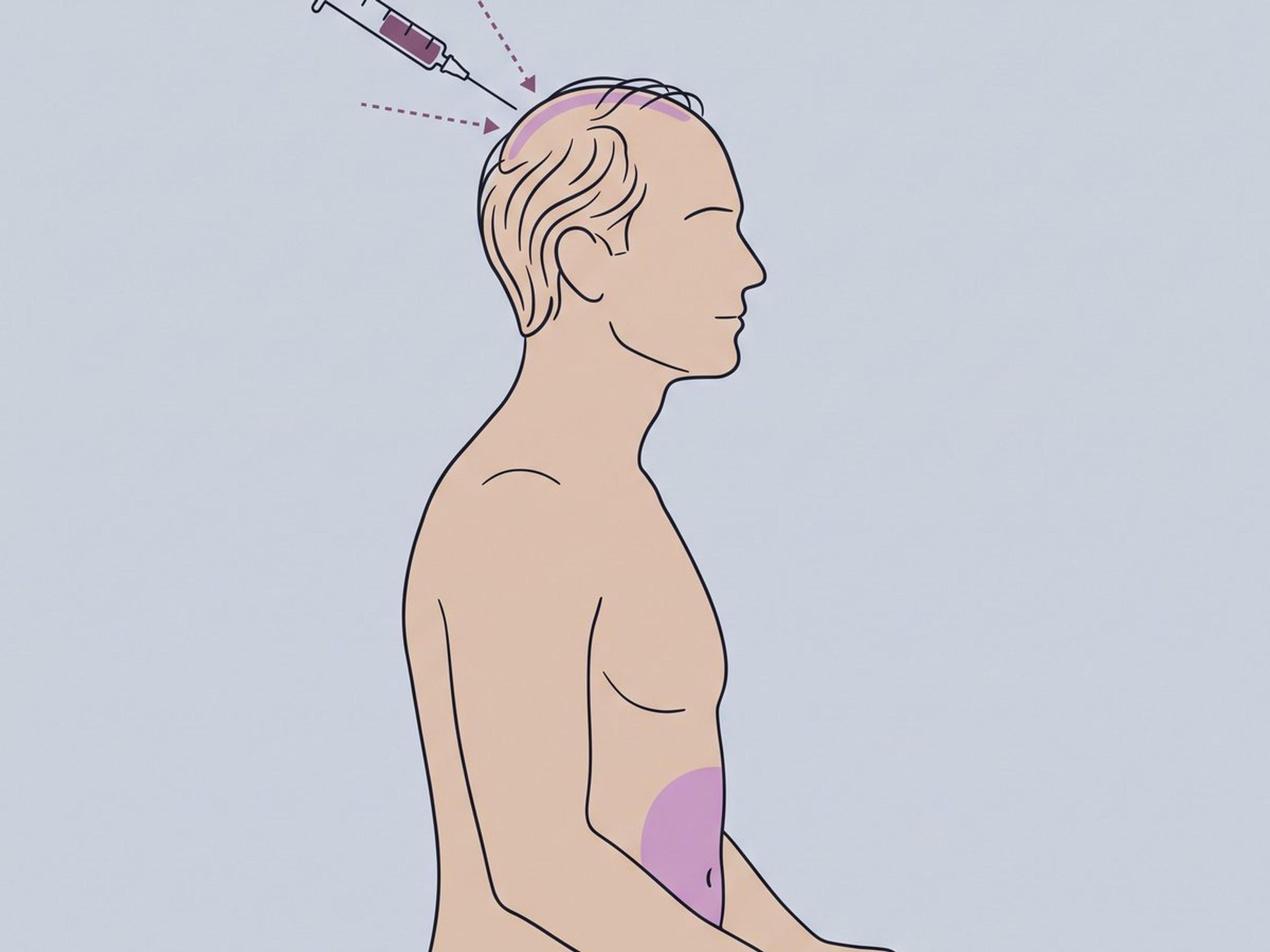
Fat is taken by small-volume liposuction and processed chairside, enzymatically or mechanically, into a mixed cell population — mesenchymal stromal cells, pericytes, endothelial cells — with no culture expansion. It is injected intradermally into the thinning scalp, sometimes alongside platelet-rich plasma or fat grafting. The density improvements reported for this route are among the largest in the literature, but they come from small, mostly uncontrolled series, and the harvest leaves you a second site to look after.
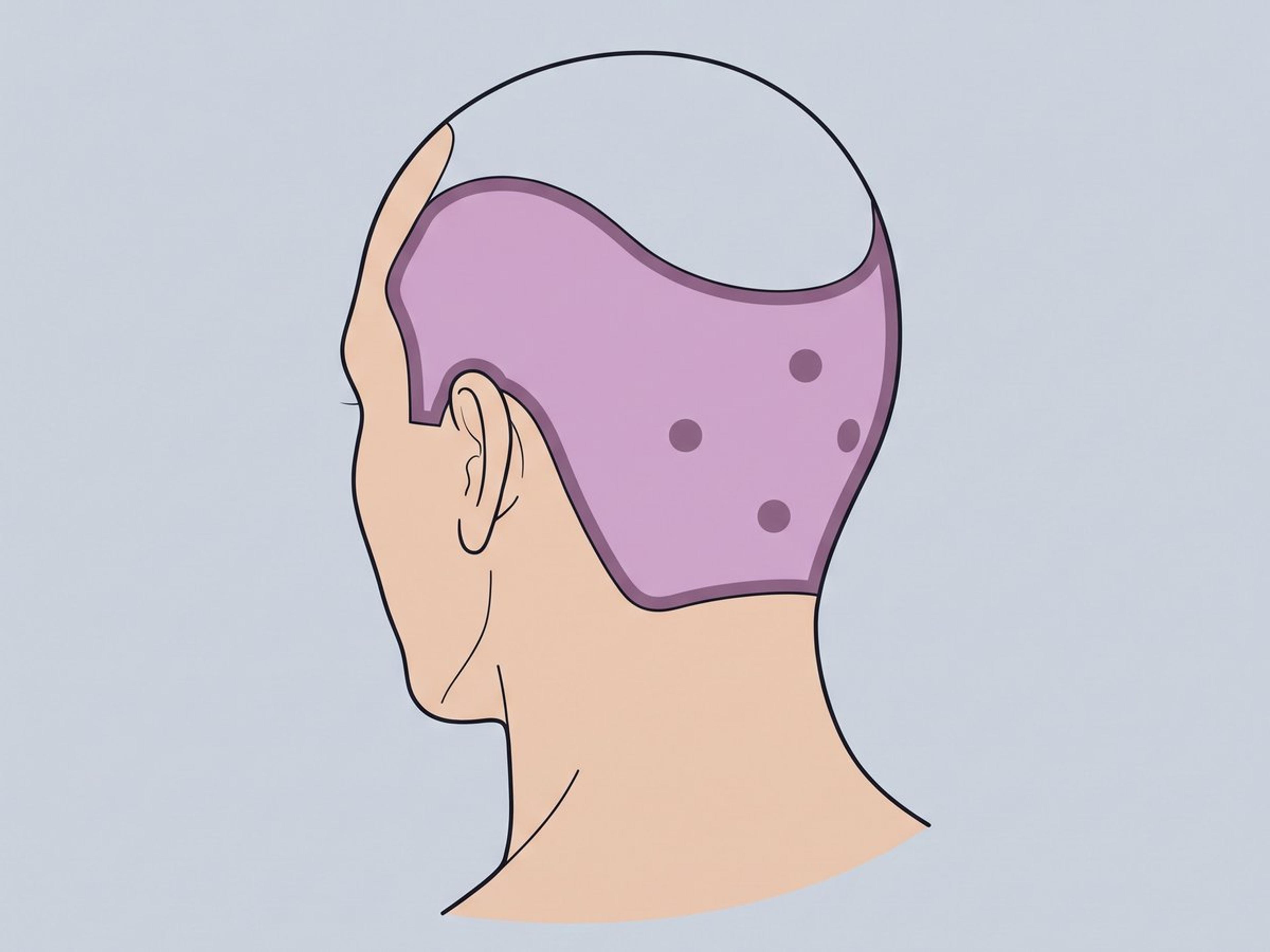
Punch biopsies are taken from the donor-dominant occipital scalp and processed into a suspension of hair follicle stem cells, dermal sheath cup cells or autologous cell micrografts, then reinjected into the recipient area. This is the route with randomised data behind it — dermal sheath cup cells produced significant increases in total hair density and cumulative hair diameter at 6 to 9 months against placebo. Cell yield from a biopsy is low, and the effect of a single injection has been described as transient.
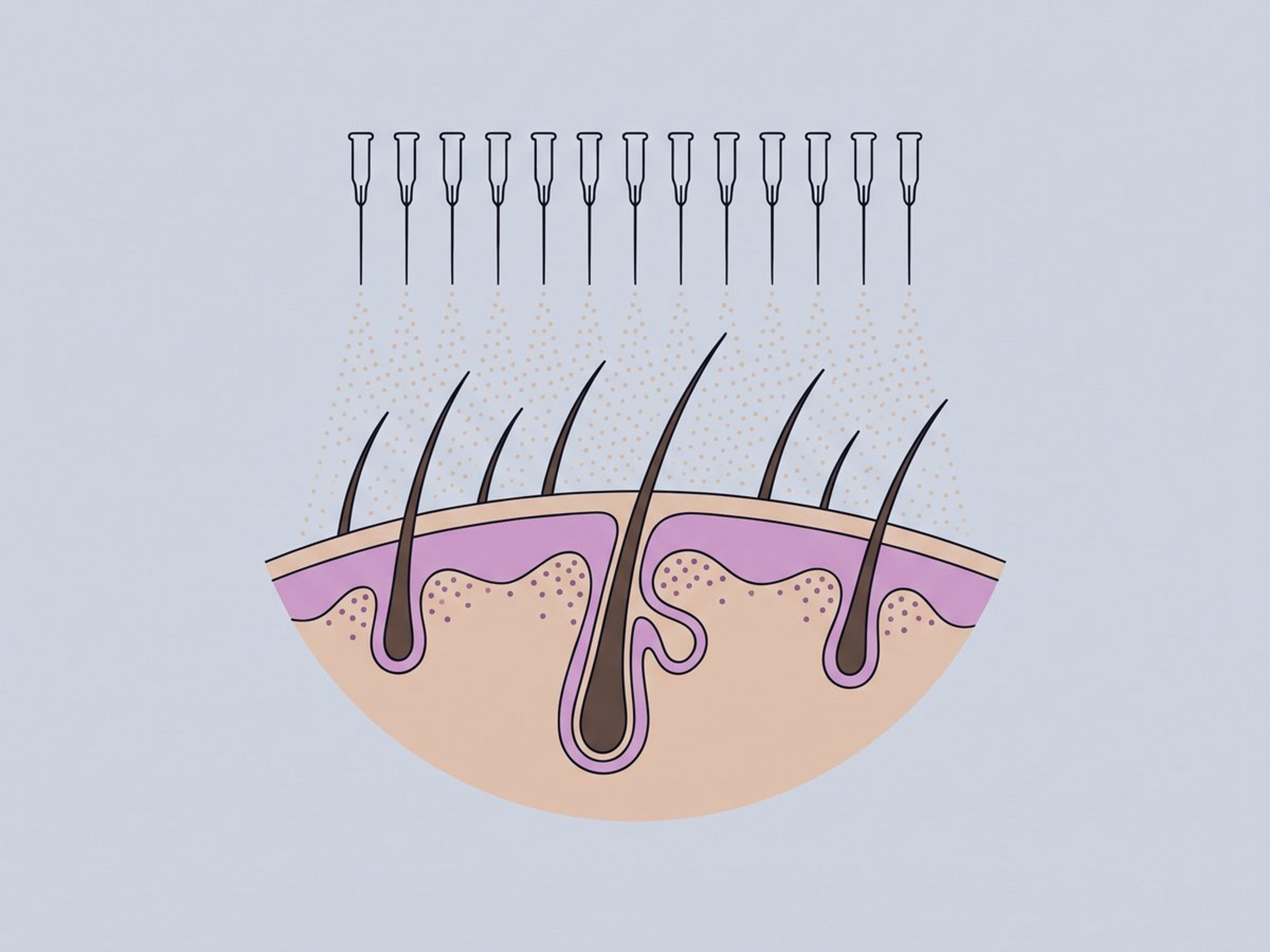
Here no cells are injected at all — what is used is the culture fluid the cells were grown in, carrying their secreted growth factors and cytokines. It is delivered by intradermal injection, mesotherapy, microneedling, or after non-ablative fractional laser. A 2024 meta-analysis of 10 clinical trials found a pooled hair-density increase of about 15 hairs/cm² and a thickness increase of about 19 μm, with longer treatment courses outperforming shorter ones.
A session, step by step
Trichoscopy and baseline mapping
Before anything is injected, hair counts are taken by trichoscopy at fixed, reproducibly located scalp points and photographed under standardised lighting. Without that baseline there is no honest way to tell a real gain at 6 months from a good hair day, and the published density figures are only meaningful because they were measured this way.
Harvest — only if your protocol needs one
For stromal vascular fraction, a small volume of fat is taken from the abdomen or flank under local anaesthetic. For follicle-derived cells, two or three punch biopsies are taken from the donor-dominant occipital scalp. Conditioned-medium protocols skip this step entirely, which is why they carry no donor site and no second wound to look after.
On-site processing while you wait
The harvested tissue is processed at the clinic — enzymatically or mechanically for fat, by disaggregation for follicular punches — into an injectable cell suspension, typically over 45 to 90 minutes. It is done on site rather than shipped because the preparation is autologous and used the same session, which keeps identity and handling traceable to you.
Topical anaesthesia and injection mapping
The scalp is numbed under topical anaesthetic for around 30 minutes, and the treatment zone is marked against the trichoscopy map. The marking matters: the target is miniaturised but living follicles, not scarred scalp where nothing will respond and not the dense areas that need no help.
Intradermal delivery across the thinning zone
Small aliquots are placed intradermally on a grid across the marked area, at the depth of the dermal papilla rather than into fat or onto the surface. Some protocols combine this with microneedling or follow non-ablative fractional laser, which is a delivery decision rather than a second treatment.
Observation, review and the next date
You are watched briefly, then discharged the same day with written aftercare; a donor site is dressed before you leave. The next session is booked 3 to 5 weeks out, because it is course length, not any single session, that the published data associates with benefit.
Hair stem cell treatment: recovery week by week
- Day 1
The scalp is tender, pink and pinpoint-bleeding with mild swelling, and that settles over the day. Leave the hair unwashed for 24 hours and keep heat, dye and friction off it. If fat or follicles were taken, that site is dressed and sore.
- Days 2–7
Wash gently with lukewarm water from day 2 and go back to desk work whenever you feel like it. Leave hard training, sauna and swimming pools until about day 7 — sweat and friction over fresh injection sites are an infection route, not a healing one. Punch-biopsy sites crust and close within the week; abdominal or flank bruising peaks around day 3, then fades.
- Weeks 2–4
Nothing visible is happening yet, and some people shed a little more than usual in this window as follicles are pushed into a new cycle. If your protocol runs to more than one session, the next one falls here. Keep taking minoxidil, finasteride or spironolactone throughout — this does not replace them.
- Month 3
This is the earliest point at which anything measurable appears, and it appears first as short, fine, weakly pigmented hairs rather than as visible coverage. Most published courses finish around 12 weeks, so month 3 marks the end of treatment, not the end of waiting.
- 6 months
The assessment point. Trichoscopy and photography are repeated at the same fixed points and compared with your baseline, because this is where the trials report their primary outcome — and where a gain either exists on the count or does not. Full activity, sun and hair treatments are long since unrestricted.
- 12 months
The durability check, and the one most clinics skip. The androgen-driven miniaturisation that caused the loss carries on underneath any gain, so a 12-month recount is what tells you whether to repeat the course, change the plan, or stop.
Hair stem cell treatment: how to prepare
- Get a formal diagnosis first, from a board-certified dermatologist — scalp and nail examination, a hair pull test, and blood tests or a scalp biopsy where deficiency, thyroid disease or scarring alopecia is in question.
- Start or optimise the evidence-based baseline therapy before you consider this — topical minoxidil for men and women, oral finasteride for men, spironolactone for women — and keep taking it. Hair regrown on these is lost when they are stopped.
- Ask us in writing what the product is, its cell source, whether it is autologous or donor-derived, and whether it is FDA-approved or given under an FDA-overseen clinical trial. The FDA runs a public contact line for exactly this question.
- Have standardised baseline photography and trichoscopic hair counts taken at fixed, reproducibly located scalp points, so the change at 6 months can be measured rather than estimated.
- Follow the surgeon's instructions on anything that increases bleeding and bruising, and plan for the donor site — abdomen, flank or occipital scalp — if a fat or follicular harvest is part of your protocol.
Hair stem cell treatment: risks
Every operation carries risk. We name them so you can ask the right questions.
- Injection-site reactions — pain, redness, swelling, bruising and folliculitis. Generally self-limited in the published trials.
- Infection, at the scalp injection site or at the donor site. Serious infections including sepsis have been documented where regenerative products were contaminated or defectively manufactured.
- Donor-site complications from liposuction or punch biopsy harvest — haematoma, contour irregularity, scarring and delayed healing.
- Unresolved long-term safety. Cells expanded in vitro can acquire morphological or genetic changes during culture, and the tumorigenic risk this raises is theoretical rather than excluded.
- Immune reaction, disease transmission or graft-versus-host disease where allogeneic material is used — donor, cord blood, amniotic or placental — rather than your own cells.
- No measurable regrowth at all, or a benefit that fades after a single session. Product identity, cell content and potency are frequently undisclosed by commercial suppliers.

Hair stem cell treatment in Turkey: what to expect
This is a day case. You are in and out in an afternoon, and the honest logistical question is not recovery — it is the course. Published protocols run from a single session to 6, spaced 3 to 5 weeks apart, so one trip rarely finishes the treatment.
Before you fly
Talk to the physician before you book the flight, not after you land. Agree in writing how many sessions your protocol runs to, whether the remaining ones mean returning to Istanbul, and what each of them costs — you are buying a course that unfolds over months, not a trip. Ask what regulatory basis we are operating under, and expect a straight answer: a treatment offered abroad is not thereby approved abroad. In the EU, cell products that are substantially manipulated are advanced therapy medicinal products requiring central authorisation, and no stem cell product is approved anywhere for hair loss.
At the clinic
You arrive in the morning and leave the same day. If your protocol is stromal vascular fraction, a small volume of fat is taken from the abdomen or flank under local anaesthetic and processed on site while you wait; if it is follicle-derived or conditioned medium, there is no fat harvest and the session is injections alone. The scalp itself is treated under topical anaesthesia. Cell harvest and processing are done under surgical-care standards: patient identification, infection prevention, anaesthesia, records and staff credentialling. None of that is a statement that the therapy works, and we will not present it as one.
Recovery in Istanbul
Plan on 2 days and 2 hotel nights. There is 1 follow-up review before you go — we look at the injection sites, and at the donor site if there was a harvest. On day 1 the scalp is tender, pink and pinpoint-bleeding, with mild swelling; if fat or follicles were taken, that site is sore, dressed and may bruise. Desk work is usually possible the same day or the next, and the city is not off-limits.
Heading home
Fly on day 2. There is no clot-related reason to wait — this is a day case under local or topical anaesthesia, with no drains, no occlusive dressing and no immobility, and travel-thrombosis guidance keys its precautions to surgery under general anaesthetic lasting more than 30 minutes. Day 1 is the true minimum, and it exists only so the follow-up happens before departure. If fat was harvested, the abdominal or flank site stays dressed and bruised for several days — a comfort and wound-care reason to prefer day 2, not a clotting one. Move and drink water on the plane, as you would on any flight.
Checking a clinic in Turkey
Turkey rewrote its medical-tourism rules on 26 April 2025, replacing the 2017 regulation. Any facility treating international patients must now hold an international health tourism authorisation certificate, register on the Ministry of Health's HealthTürkiye portal, and carry complication insurance for the procedures it performs; hospitals and medical centres also had to complete TÜSKA accreditation by the end of that year. Facilities are required to publish that certification — so you can check ours, and you should check anyone else's before you pay a deposit.
What the rules do not settle is who actually performs the procedure. Turkey has clinics where a doctor plans the design and technicians carry out the extraction and implantation with little supervision — so ask, by name, which doctor is responsible for your case and which parts they do themselves. Ask for their Turkish Medical Association registration. If an agency is arranging the trip rather than the clinic, get it in writing who carries clinical responsibility when something needs correcting.
Most nationalities enter Turkey visa-free or on an e-Visa for a stay of this length, with a passport valid at least six months. Confirm the rule for your own passport, and build the return flight around the last clinic visit rather than fixing it in advance.
Hair stem cell treatment: frequently asked questions
Is stem cell treatment for hair loss FDA-approved?
No. The only stem cell products the FDA has approved are blood-forming cells derived from umbilical cord blood, approved for disorders of the blood system and nothing else, and there are no FDA-approved exosome products for any indication. Any stem cell hair treatment offered outside an FDA-overseen clinical trial — here or anywhere — is being provided without that approval.
Does it actually regrow hair?
Published studies do report increases in hair density and shaft thickness, but they disagree with one another and the evidence base is weak. A 2023 systematic review of 15 studies and 653 patients found density gains from roughly 18% to over 48% depending on cell type, while a 2025 review of 17 studies found 12-month changes spanning a small loss to a gain of 30 hairs/cm². Only a minority of these studies were randomised, follow-up was short, and preparation methods were not standardised.
How is this different from PRP?
Platelet-rich plasma concentrates your own platelets from a blood draw and delivers their growth factors to the scalp — no tissue is harvested. Stem cell treatments take cells, or the medium those cells were cultured in, from fat or from hair follicles, which means liposuction or punch biopsy and in some protocols laboratory expansion. PRP is the more extensively studied of the two, and the two are sometimes given in the same session.
What about exosome therapy — is it the same thing?
No. Exosomes are extracellular vesicles secreted by stem cells rather than the cells themselves, usually delivered topically with microneedling. Small trials have reported larger density gains than placebo at 12 weeks, but the FDA regulates exosomes as biologics and has approved no exosome product for any use. An analysis of 18 commercial suppliers found a common lack of disclosure of clinical data, quality control and active ingredients.
How many sessions will I need, and when would I see anything?
Most published protocols run over roughly 12 weeks — some a single injection session, others 10 to 12 topical or microneedling applications, and some up to 6 sessions 3 to 5 weeks apart. Assessment is set at 6 months, with 12 months used to test whether anything lasts. Longer courses did better than shorter ones in the conditioned-medium meta-analysis, which is why one flight rarely completes a course.
Can it replace minoxidil, finasteride or a hair transplant?
No. Minoxidil and finasteride remain the only medications FDA-approved for pattern hair loss, and hair regrown on them is lost when they are stopped. The literature positions cell treatment as an adjunct, or as an option for non-responders, and it cannot restore hair in scarred areas where follicles have been destroyed — which is what transplantation addresses.
Who performs the injections?
A physician, in a medical dermatology or plastic surgery service. Turkish regulation tiers cosmetic procedures into physician-only, physician-supervised and trained-non-physician categories, and a review of Turkish Supreme Court cases on adverse outcomes after minimally invasive cosmetic interventions found 26.5% had been carried out by an unauthorised person. Ask us for the name and the specialty registration before you travel — and ask any other centre the same thing.
What does it cost?
There is no citable US average for this procedure — the ASPS fee tables cover cosmetic surgery only and carry no line item for hair restoration or any regenerative hair procedure. In Istanbul it is sold per session rather than per graft or per cm²: roughly €300 to €800 a session for injection-only protocols, and €1,000 to €2,000 for a single stromal vascular fraction session, which carries the cost of the harvest and the on-site processing. A typical course of 2 to 3 sessions therefore comes to roughly €600 to €3,200 as of 2026, depending on which preparation you have. Because it is not approved for hair loss, no insurer covers it.
Who is not a candidate for this?
Anyone whose hair loss has not been properly diagnosed, first of all — the injections do nothing in scarring alopecia, where the follicles have already been destroyed, and nothing useful in a telogen effluvium that would have recovered on its own. Beyond that, the exclusions used in the published protocols and the standard contraindications to injectable and cell-based treatment apply: pregnancy and breastfeeding, because none of this has been studied in either and postpartum shedding makes any assessment meaningless; an active scalp infection or folliculitis in the area to be treated, which has to be cleared first; a bleeding or clotting disorder, or anticoagulant therapy that cannot be safely paused; uncontrolled diabetes, immunosuppression or anything else that impairs wound healing, which matters most at a fat or punch-biopsy donor site; and active or recent cancer, given that the long-term oncological safety of culture-expanded cells is unresolved rather than excluded. Too little donor fat rules out a stromal vascular fraction harvest specifically, not the injection-only protocols. Tell the physician everything you take, minoxidil, finasteride and supplements included.
What should make me contact the clinic afterwards?
A tender, pink scalp with pinpoint bleeding and mild swelling on day 1 is expected and settles. Contact us — or a doctor where you are, if you have already flown home — if redness spreads outward from the injection sites or the scalp feels hot to the touch; if there is pus, foul-smelling discharge or a crust that keeps enlarging; if you run a temperature above 38°C or feel shivery and unwell; if pain climbs after day 2 instead of easing, or is out of proportion to an afternoon of injections; or if swelling appears suddenly rather than fading. If fat was harvested, the same applies to the abdomen or flank: a donor site that becomes tense, rapidly swollen or steadily more painful needs to be looked at rather than waited out, because that is how a haematoma or a wound infection presents. Serious infections after regenerative products are uncommon, but they are documented — and they are straightforward to treat early.
If it works, is the result permanent?
Assume not, and plan for maintenance. The trials that report a benefit measure it at 6 months and, at best, retest at 12 — there is almost no published follow-up beyond a year, and the effect of a single injection has been described in the randomised work as transient. Nothing in this treatment changes the androgen-driven miniaturisation causing the loss, so that process carries on underneath whatever gain you get. That is exactly why we position it as an adjunct to minoxidil or finasteride rather than a course you finish, and why you should budget for repeat sessions rather than one trip. If anyone tells you a single round of cell treatment permanently reverses pattern hair loss, ask them for the 12-month data.
How much does hair stem cell treatment cost in Turkey?
€600 to €3,200 with us, confirmed after a consultation rather than quoted blind. Priced per session, and the range reflects how many sessions a course needs. We would rather tell you the evidence here is still early than sell you a package of six.
Sources
- [1]Consumer Alert on Regenerative Medicine Products Including Stem Cells and Exosomes · U.S. Food and Drug Administration (FDA) · 2024
- [2]Concise Review: A Safety Assessment of Adipose-Derived Cell Therapy in Clinical Trials: A Systematic Review of Reported Adverse Events · Stem Cells Translational Medicine, via PubMed Central · 2017
- [3]Human Stem Cell Use in Androgenetic Alopecia: A Systematic Review · Cells (PubMed Central, NLM) · 2023
- [4]Stem cell-derived conditioned medium for alopecia: A systematic review and meta-analysis · Journal of Plastic, Reconstructive & Aesthetic Surgery (PubMed) · 2024
- [5]Adipose-derived stromal vascular fraction (SVF) for the treatment of androgenic alopecia (AGA): a systematic review · Acta Biomedica, via PubMed Central · 2023